
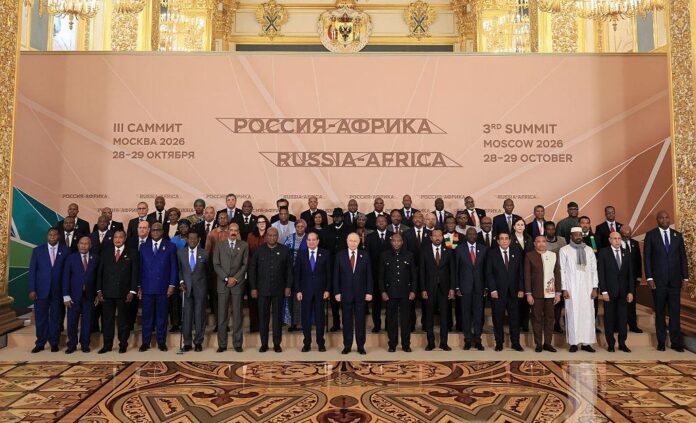
MOSCOW, Russia – African leaders have concluded a two-day summit with Russian President Vladimir Putin in Moscow, securing fresh commitments on trade, industrialisation, food security and diplomatic cooperation as Russia seeks to expand its influence across the continent. However, the Russia–Africa Summit 2026 has also raised questions about whether Moscow can turn its promises into substantial investment and economic opportunities for African countries.
The gathering, held on 28 and 29 October, brought together delegations from 48 African nations, including 22 heads of state. Discussions covered energy, mining, agriculture, transport infrastructure, technology and security, alongside calls for a greater African role in international decision-making.
Putin presented Russia as a partner willing to support African industrial development, local production and economic independence. He also criticised Western governments over their historical relationship with Africa and what he described as unequal economic arrangements.
His remarks reflected Moscow’s wider effort to strengthen relationships with African governments while facing continued international pressure over its war in Ukraine.
African leaders, meanwhile, approached the summit with their own priorities. Greater access to investment, infrastructure financing, agricultural technology and international markets remains essential to efforts to expand manufacturing and create employment across the continent.
The summit concluded with a declaration supporting a more multipolar international order, national sovereignty and reforms to global institutions. Participants also called for stronger cooperation in trade, energy, security and emerging technologies.
Russia backed African demands for permanent representation on the United Nations Security Council, an issue that has remained central to the continent’s diplomatic agenda.
African governments have long argued that the current structure of the Security Council fails to reflect the continent’s population, political importance and contribution to international peace and security.
Support from Moscow adds diplomatic weight to those demands, although reform would require agreement among UN member states and changes to the organisation’s founding arrangements.
Economic cooperation formed another major part of the discussions. Putin said trade between Russia and African countries exceeded US$27 billion in 2025, pointing to opportunities for further expansion in agriculture, manufacturing, energy and transport.
The figure demonstrates the scale of existing commercial relationships, but it also exposes the distance between Russia’s economic ambitions and its actual presence in African markets.
Moscow previously set a target of increasing annual trade with Africa to US$40 billion. Despite several years of diplomatic engagement, that goal has not been achieved.
Russia’s trade with the continent also remains considerably smaller than Africa’s commercial relationships with China and the European Union.
According to an analysis published by Chatham House ahead of the summit, China recorded approximately US$348 billion in trade with Africa in 2025, while trade with the European Union reached about US$395 billion.
These differences matter because diplomatic agreements alone cannot transform economic relationships. Sustained investment, competitive products, functioning transport networks and reliable financial systems are necessary to increase trade.
Putin sought to address some of these challenges by proposing greater cooperation in industrial production.
Russian companies are interested in establishing or relocating selected manufacturing operations in African countries, he said, arguing that industrial partnerships could create jobs and support technology transfer.
The proposal could appeal to African governments seeking to process more of their natural resources domestically rather than exporting raw commodities.
Countries rich in minerals, agricultural products and energy resources have increasingly prioritised local manufacturing as a means of retaining more economic value.
However, the commercial viability of new industrial projects will depend on financing, electricity supply, infrastructure and access to markets.
Russia’s own economic constraints, including sanctions linked to the Ukraine war, could also affect its ability to finance and sustain major overseas investments.
Agriculture emerged as another important area of cooperation. Putin said Russia supplied more than 18 million tonnes of grain to African countries in 2025 and approximately 13 million tonnes during the first nine months of 2026.
He pledged continued grain and fertiliser supplies, presenting Russia as an important partner in addressing food security challenges.
Several African economies depend on imported wheat and fertilisers, making them vulnerable to global price changes, shipping disruptions and currency fluctuations.
Reliable agricultural imports can help stabilise supplies, but longer-term food security also depends on investment in African farming, irrigation, storage facilities and domestic fertiliser production.
The distinction is significant. Expanding imports may address immediate shortages without necessarily reducing structural dependence on external suppliers.
Energy cooperation featured prominently, particularly nuclear power, natural gas and electricity infrastructure.
Russian state-owned companies have pursued agreements with several African governments seeking to diversify their energy systems and expand generation capacity.
Egypt’s El Dabaa nuclear power plant remains under construction, while other proposed projects across the continent are at different stages of planning and negotiation.
The summit declaration also identified critical minerals processing, transport infrastructure and digital technologies as potential areas for expanded cooperation.
These sectors are important to Africa’s industrial ambitions, particularly as demand grows for minerals used in batteries, renewable energy and advanced manufacturing.
Yet the economic benefits will depend on whether future agreements support processing and production within African countries rather than simply increasing exports of unprocessed resources.
Security cooperation remained a significant part of Russia’s engagement with the continent.
Moscow has expanded military relationships with several African governments, particularly in the Sahel, where Mali, Burkina Faso and Niger have developed closer ties with Russia after distancing themselves from traditional Western security partners.
Russian military personnel and contractors have become involved in security operations in parts of the region.
Supporters of these partnerships argue that African governments should have the freedom to choose security arrangements that reflect their national priorities.
Critics, however, question the effectiveness and accountability of Russian-backed operations, particularly as extremist violence continues to affect communities across the Sahel.
Russia’s growing security presence has also raised concerns among Western governments, which accuse Moscow of using military cooperation to expand political influence and secure access to strategic resources.
Moscow rejects allegations that its engagement is exploitative and maintains that its partnerships respect African sovereignty.
The summit took place against this wider competition among global powers seeking stronger relationships with African countries.
China, the European Union, the United States, India, Türkiye and Gulf states are also pursuing opportunities in African infrastructure, manufacturing, energy and trade.
African governments consequently have more potential partners, but they also face difficult decisions about financing terms, debt exposure, technology transfer and control over strategic assets.
Diversifying international partnerships can create opportunities to negotiate more favourable agreements. However, the benefits depend on the ability of governments to establish clear commercial priorities and protect national economic interests.
The African Continental Free Trade Area provides an important framework for these ambitions by seeking to expand trade among African economies and support regional value chains.
External investment that strengthens African manufacturing and regional trade could contribute to those objectives. Agreements focused primarily on extracting resources or supplying imported goods may deliver narrower economic benefits.
The Moscow declaration calls for expanded cooperation in industrialisation, financial systems, artificial intelligence, healthcare and education.
It also proposes stronger dialogue on terrorism, food security and information security.
These commitments establish areas of potential cooperation, but they do not mean that the projects discussed have already received financing or entered implementation.
That distinction will be central to assessing the summit’s longer-term significance.
Russia has hosted three major summits with African countries since 2019, creating platforms for diplomatic engagement and commercial negotiations.
The latest gathering demonstrated Moscow’s continued interest in the continent and the willingness of African governments to maintain relationships with a range of international partners.
Nevertheless, the scale of Russia’s trade with Africa suggests that its economic presence has not yet matched its diplomatic ambitions.
African governments will therefore need to assess future agreements according to their practical outcomes, including investment delivered, industries established, infrastructure completed and employment created.
The Russia–Africa Summit 2026 has produced a broad agenda for cooperation, but the more consequential decisions will follow in the months and years ahead.
Africa’s economic priorities extend beyond choosing between competing global powers. The continent needs partnerships that expand productive capacity, improve infrastructure and strengthen its position in international trade.
Whether Moscow can contribute meaningfully to those objectives will depend less on the declarations adopted at the summit than on the economic results that follow.