


Uganda has a climate plan worth US$28.1 billion, but only a small fraction of the money needed to carry it out has reached the country. The shortfall is not just a government accounting problem. It means farmers still need irrigation, better soils, agricultural extension services and reliable markets, while public resources are under pressure from debt repayments and other spending demands.
The financing crisis was among the issues discussed at a Climate Media Café organized by ActionAid and the Media for Environment, Science, Health and Agriculture (MESHA) on October 29. Presentations examined Uganda’s climate commitments, the economic case for agroecology and the growing debt burden facing climate-vulnerable African countries.
Uganda’s 2022 Nationally Determined Contribution (NDC) estimates that the country needs US$28.1 billion by 2030 to implement its climate commitments. Adaptation accounts for US$17.7 billion, mitigation US$10.3 billion and cross-cutting measures US$100 million. A Ministry of Finance presentation to the UN climate convention in June 2026 put disbursements since 2022 at US$1.6 billion, or 5.7 per cent of the target, leaving a US$26.5 billion gap.
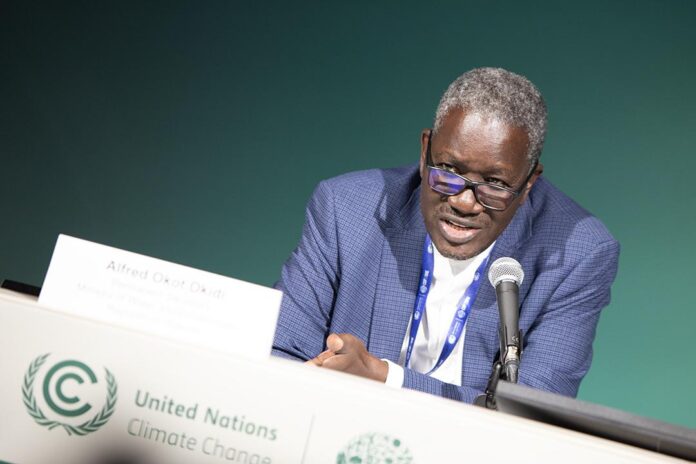
The financing challenge has been acknowledged by the Ministry of Water and Environment. In the foreword to Uganda’s NDC Action Project final report in August 2024, Permanent Secretary Alfred Okot Okidi wrote that the gap could be bridged by mobilizing “adequate, accessible, innovative, and sustainable financing” from public and private sectors, including domestic and multilateral financial institutions.
The question is whether that financing will reach farmers and communities, whose livelihoods are already exposed to changing weather patterns.
Presenting ActionAid’s multi-country agroecology research, Bavon Christopher, ActionAid country Director, Tanzania said the study covered Uganda, Kenya, Tanzania, Ethiopia, Zambia, Zimbabwe, Nigeria, Ghana, The Gambia and Malawi. Field research was conducted in Kenya, Nigeria and Zimbabwe.
The Kenyan findings offered a strong economic argument for agroecology. Households using agroecological practices recorded broad productivity of 926,932 Kenyan shillings per hectare, compared with 672,213 shillings under conventional farming – a difference of 37.8 per cent. A separate multi-year organic trial found long-term profitability was 53 per cent higher where farmers accessed premium markets offering price advantages of 25 to 50 per cent.
Nigeria’s crop comparisons were equally notable. Agroecological farms produced 3.6 tonnes of maize per hectare against 2.9 tonnes under conventional methods. Cassava yields stood at 18 tonnes against 14, while vegetable production reached 7.3 tonnes compared with 5.2 tonnes. The presentation put the increases at 24 per cent for maize, 28 per cent for cassava and 40 per cent for vegetables.
The research also reported pigeon pea and sorghum yields almost tripling in Tanzania, cereal yields increasing by 41 per cent in Ghana when legumes were used in crop rotations, and maize yields on Zambian demonstration plots reaching up to twice those of comparison plots.
These figures are not Uganda’s results, and although Uganda was among the ten countries covered, the presentation did not provide equivalent Uganda-specific yield or profitability figures. The comparisons nevertheless raise questions about whether Ugandan farmers are getting enough research support, training and investment to adopt practices that have shown promise elsewhere.
Bavon identified several obstacles: underfunded agriculture budgets, subsidies favoring synthetic fertilizers and chemical inputs, weak research and extension services, the cost of changing farming systems and limited access to markets. He argued for multi-year transition grants, farmer training, and local production of bio-inputs, labor-saving tools, storage and processing facilities.
One of Bavon’s presentation’s closing messages challenged policymakers to look beyond announcements and examine what reaches farmers: “How much? By when? And how will smallholders benefit?”
The pressure on climate budgets is made worse by debt as ActionAid’s International Climate Justice Lead, Teresa Anderson described the relationship between debt and climate change as “a toxic relationship”. ActionAid’s analysis found that 93.5 per cent of the most climate-vulnerable countries were in, or at risk of, debt distress. The countries were spending about 65 per cent of national revenue on debt servicing and nearly 25 times more on debt repayments than on climate action.
The country examples showed how little room some governments have left for investment. ActionAid said Malawi’s debt repayments amounted to 129 per cent of tax revenue. Zambia spent more than 60 per cent of its budget and 70 per cent of revenue servicing debt, while allocating only 0.32 per cent of government expenditure to climate activities. Senegal spent about 600 times more on debt servicing than climate action, while Mozambique spent 117 times more. Nigeria used nearly half its revenue to repay debt, while almost 40 per cent of its population lacked electricity.
The Ministry of Finance report shows Uganda is also dealing with rising debt, with a public debt of US$37.12 billion at the end of June 2026. External debt service reached US$1.42 billion in the 2025/26 financial year. Although these figures are not directly comparable with ActionAid’s ratios for other countries, they underline the pressure that debt repayments can place on public investment.
Teresa also drew attention to the impact on women and girls. She noted that climate shocks can force women to walk longer distances for water, skip meals and struggle to keep girls in school. When debt pressures lead to cuts in health, education and other public services, women often take on more unpaid care work. Yet they remain central to food production and community adaptation.
ActionAid called for debt cancellation, grant-based climate finance and more direct support to farmer- and women-led organizations. These are the organization’s recommendations, rather than agreed government decisions.
Uganda has signaled the need to attract more investment. Speaking during the launch of the NDC 3.0 process in July 2025, Okidi said: “We aim to develop an investment-grade NDC that is implementable and trackable. Our focus is on adaptation, creation of green jobs, and security for the future of the next generation.”
For farmers, the difference will be seen in access to irrigation, extension officers, improved soil management, affordable inputs and markets for their produce. Without that support, Uganda’s climate commitments risk remaining plans on paper while households continue to absorb the cost of droughts, floods and unreliable seasons.