


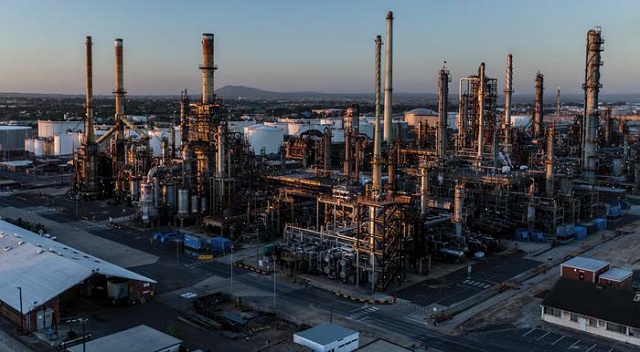
JOHANNESBURG – South Africa could need more than $8 billion to restore two state-owned oil refineries, confronting Africa’s most industrialised economy with a difficult choice between rebuilding domestic refining capacity and continuing its growing dependence on imported fuel.
The estimated cost covers the Sapref refinery in Durban and Natref in Sasolburg, according to information presented to South African lawmakers. Both facilities form part of a refining industry that has contracted sharply in recent years following shutdowns, accidents and investment delays.
South Africa once had refining capacity of more than 700,000 barrels per day, supported by several major facilities around the country. Much of that capacity is now unavailable, forcing the country to import a growing share of the petrol, diesel and other petroleum products consumed by households, transport companies, mines and industry.
Restoring Sapref and Natref could strengthen domestic fuel production, but the scale of the required investment raises questions about whether rebuilding ageing facilities represents the most effective use of capital. More than $8 billion would make the programme one of South Africa’s largest industrial investments at a time when government finances remain constrained.
Sapref has historically been the largest crude oil refinery in Southern Africa, with capacity of around 180,000 barrels per day. Shell and BP previously owned the facility before selling it to South Africa’s state-owned Central Energy Fund for a symbolic one rand in 2024.
The Durban refinery had already stopped normal operations in 2022 after its former owners announced an indefinite pause. Severe flooding in KwaZulu-Natal later damaged parts of the facility, adding to the investment required before large-scale refining could resume.
Natref has remained an important part of South Africa’s fuel infrastructure. The inland refinery in Sasolburg has capacity of roughly 108,000 barrels per day and is jointly owned by the Central Energy Fund and Sasol following the state’s acquisition of TotalEnergies’ stake.
Government ownership gives Pretoria greater influence over the future of both facilities, but it also transfers more of the financial responsibility for their rehabilitation to the state.
The decision comes at a time when South Africa is reconsidering what energy security should mean for an economy that imports most of its crude oil and an increasing volume of finished petroleum products. Domestic refineries do not remove dependence on international oil markets, but they can change the type of products the country imports and provide greater control over local fuel production.
Importing finished petrol and diesel allows South Africa to avoid the enormous capital cost of modernising old refineries. However, greater dependence on overseas refining also exposes the economy to international shipping disruptions, refinery shortages and changes in global fuel markets.
Those risks have become more visible since the COVID-19 pandemic and the disruption of global energy markets following Russia’s invasion of Ukraine. Conflict and shipping insecurity around major maritime routes have added another reminder that fuel supply chains can become vulnerable far beyond South Africa’s borders.
South Africa’s refining decline accelerated over the past decade. The Engen refinery in Durban stopped crude refining after a major fire in 2020, while Sapref later suspended operations. The Cape Town refinery, previously operated by Astron Energy, also experienced an explosion in 2020 before eventually returning to production.
The closures transformed the structure of the domestic petroleum market. South Africa increasingly shifted from importing crude for local processing towards importing larger quantities of finished fuel, requiring ports, storage terminals and pipelines to handle a different supply model.
That transition has consequences for infrastructure investment. If South Africa chooses not to restore substantial refining capacity, it will need enough port, storage and distribution infrastructure to support higher volumes of imported petrol, diesel and aviation fuel reliably.
Rebuilding refineries creates a different set of costs. Ageing plants require extensive modernisation to meet fuel specifications, environmental standards and operational requirements. Investors must also consider whether traditional oil refineries can generate adequate returns over several decades as electric vehicles and cleaner energy technologies gradually change petroleum demand.
South Africa therefore faces a decision that extends beyond the immediate $8 billion estimate. Refinery investments typically operate over long periods, meaning facilities restored today would need to remain economically relevant well into a global energy transition that is changing transport and industrial fuel consumption.
Petroleum will nevertheless remain important to the South African economy for years. Road freight carries a large share of domestic goods, while mining, agriculture, aviation and heavy industry continue to depend on liquid fuels. Electric vehicle adoption remains relatively limited, and replacing the existing vehicle fleet will take considerable time.
Government must therefore balance long-term energy transition goals with the immediate requirement to maintain secure fuel supplies. That challenge is particularly important for an economy whose transport and logistics systems depend heavily on diesel.
The refinery question also has an industrial dimension. Domestic refining supports engineering, maintenance, chemicals, logistics and other businesses linked to petroleum processing. Losing refining capacity can therefore affect employment and technical expertise beyond refinery gates.
At the same time, spending billions of dollars on ageing facilities carries an opportunity cost. South Africa requires significant investment in electricity transmission, railways, ports, water infrastructure and other areas that directly constrain economic growth. Every major state-backed industrial commitment must compete against those priorities for capital.
Private-sector participation could reduce the burden on government, but investors would need confidence that the refineries can operate competitively. Policy certainty around fuel specifications, pricing, environmental requirements and the energy transition would also influence investment decisions.
The debate comes as other African economies pursue new refining capacity. Nigeria’s Dangote refinery has changed the petroleum market in West Africa, while a proposed 700,000-barrel-a-day Dangote refinery in Lamu could create significant new capacity in East Africa if the project proceeds as planned.
Those investments illustrate contrasting stages of Africa’s refining landscape. Some countries are seeking new large-scale processing capacity while South Africa is deciding whether to spend billions restoring infrastructure built decades ago.
Regional refining capacity could eventually change South Africa’s calculations as well. Greater production elsewhere in Africa could create new sources of refined fuel imports, although geography, shipping costs, product specifications and commercial terms would determine whether those supplies compete effectively with existing international sources.
South Africa’s decision cannot therefore be reduced to a choice between energy independence and imports. The country already depends on global oil markets whether it buys crude or finished fuel. The more important question is which model offers the strongest combination of supply security, competitive pricing, industrial value and financial sustainability.
An $8 billion rehabilitation programme would represent a major commitment to domestic refining. Choosing not to make that investment would require an equally serious commitment to import terminals, storage, pipelines and other infrastructure needed to secure fuel supplies from international markets.
Either path will require substantial capital. The difference lies in where South Africa believes the greatest strategic and economic value can be created.
After years of refinery closures, that decision can no longer remain an abstract energy-policy debate. South Africa’s dependence on fuel imports is already increasing, while ageing infrastructure continues to narrow its domestic refining options. The $8 billion estimate has now put a price on one possible route back, leaving government to determine whether rebuilding its refining industry offers enough long-term value to justify the cost.