


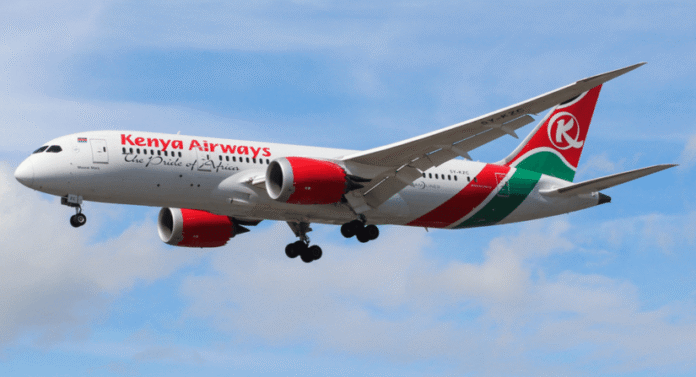
Kenya Airways is preparing to reveal potential strategic investors within weeks as the national carrier searches for fresh capital to strengthen its balance sheet, restore grounded aircraft and revive a turnaround that has been undermined by rising costs.
Interest has come from investors in the United States, China, South Africa and Singapore, according to chairman Kiprono Kittony. The search comes as Kenya Airways reported a pre-tax loss of KSh15.92 billion, about $123 million, for the first half of 2026.
That compares with a KSh12.17 billion loss during the same period last year, highlighting the financial pressure facing one of Africa’s most recognisable airlines even as passenger demand remains strong.
Revenue increased by about 9% to KSh81.2 billion during the six months to June, but higher operating expenses eroded those gains. Fuel became an especially significant burden, with costs rising sharply during the period as geopolitical tensions pushed global energy prices higher.
Aircraft availability has created another obstacle. Maintenance delays and shortages of spare parts have kept some planes on the ground, limiting the number of passengers Kenya Airways can carry at a time when demand could otherwise support stronger revenue growth.
The combination has left the airline confronting a familiar aviation problem: demand exists, but insufficient aircraft capacity and high operating costs make it difficult to convert that demand into sustainable profit.
Finding an investor has therefore become central to Kenya Airways’ next phase. The airline is looking beyond a simple injection of cash and wants a strategic partner capable of bringing capital, aircraft or aviation expertise into the business.
One potential investor has proposed providing aircraft in exchange for equity, according to the airline. Such an arrangement could help address two problems at once by strengthening the fleet while reducing the immediate cash required to acquire additional planes.
Kenya Airways has not identified the interested parties, and no final investor has been selected. Kittony says the company plans to conduct an open process as it assesses potential partners and determines the structure that offers the strongest long-term value.
The airline’s status as Kenya’s national carrier adds another layer to those negotiations. The government remains its largest shareholder, and officials want the country to retain significant ownership even if a substantial private investor joins the business.
That balance will be difficult to strike. Kenya Airways needs enough external capital to repair its finances and fund future growth, but Nairobi is unlikely to support an arrangement that substantially weakens national influence over a strategically important airline.
Earlier estimates from the company suggest the scale of the challenge. Kittony said in June that Kenya Airways could require about $1.5 billion in new capital to support its longer-term transformation and expansion plans.
The airline wants to grow its fleet to about 60 aircraft by 2030 and potentially 100 by 2035. Reaching those targets would significantly expand its ability to compete for passengers travelling within Africa and between the continent and major international markets.
Before that expansion can happen, management must resolve more immediate financial and operational problems.
Fuel costs remain particularly difficult for African airlines. Carriers on the continent often pay more for aviation fuel than competitors in other regions, while taxes, limited refining capacity and supply constraints add further costs.
Kenya Airways has also had to manage disruptions linked to aircraft maintenance and the global shortage of parts. Modern commercial aircraft depend on complex international supply chains, leaving airlines exposed when engines or critical components take longer than expected to arrive.
Grounded aircraft are particularly costly because an airline continues carrying financial and maintenance obligations without generating passenger revenue from those planes.
Restoring more of the fleet could therefore improve Kenya Airways’ financial performance even before major expansion begins. More available aircraft would allow the carrier to increase capacity on profitable routes and take greater advantage of demand through its Nairobi hub.
Jomo Kenyatta International Airport gives Kenya Airways an important strategic position in African aviation. Nairobi connects East Africa with destinations across the continent while also serving routes to Europe, Asia and the Middle East.
That network could make the airline attractive to an international aviation partner seeking greater access to African markets.
Africa’s aviation sector remains fragmented despite a population of more than 1.5 billion people. Limited direct connections between many cities mean passengers frequently travel through hubs outside the continent, creating an opportunity for African carriers capable of building stronger regional networks.
Ethiopian Airlines has demonstrated what that scale can achieve, building Addis Ababa into one of Africa’s most important aviation hubs. Kenya Airways has many of the ingredients needed to compete more aggressively, including Nairobi’s geographic position and an established international network, but persistent financial difficulties have limited its ambitions.
The airline’s history helps explain why any new investment will face close scrutiny. Kenya Airways has undergone repeated restructuring efforts after years of losses, debt accumulation and government support.
A major restructuring in 2017 converted debt into equity, while the government has continued to play an important role in stabilising the airline. More recently, Nairobi has been working to clean up the balance sheet as part of efforts to make the carrier more attractive to investors.
Debt owed to the government and local banks could form part of another restructuring. Converting some obligations into equity could reduce financial pressure and create a stronger foundation before a strategic partner commits significant capital.
The investor search therefore represents more than another attempt to cover short-term losses. Kenya Airways needs a partner that can help improve fleet availability, strengthen its finances and support a credible expansion strategy without simply postponing its financial problems.
Passenger demand provides one reason for optimism. Revenue growth during the first half shows that travellers continue using the airline despite capacity constraints, giving management an underlying commercial base on which to build.
The more difficult question is whether Kenya Airways can operate that network profitably.
A successful investment deal could give the carrier resources to restore aircraft, modernise its fleet and reduce pressure on its balance sheet. It could also strengthen Nairobi’s position as an aviation hub as competition for African passengers intensifies.
Failure to secure the right partner would leave Kenya Airways confronting the same structural problems that have frustrated previous turnaround efforts, including expensive operations, constrained capacity and a heavy financial burden.
The identity of the investors expected to emerge in the coming weeks will therefore matter far beyond the size of their cheques. Kenya Airways needs capital, but its longer-term recovery may depend on whether the next investor brings the aircraft, expertise and strategic reach required to turn one of Africa’s best-known aviation brands into a consistently profitable airline.