


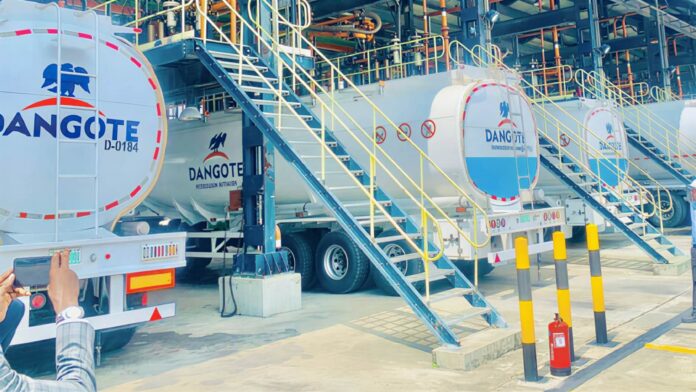
In March, the Dangote refinery produced far more petrol than the Nigerian market could absorb, creating a surplus sufficient to push significant volumes into export markets. Local reporting, based on downstream sector data, said the plant produced about 1.49 billion litres of petrol during the month, while domestic use was about 1.06 billion litres. That left roughly 434 million litres available for export.
That matters because Nigeria has spent years living with a contradiction. It is one of Africa’s biggest crude producers, yet for decades it relied heavily on imported refined fuel. Now, that pattern is starting to reverse.
Reuters reported that Nigeria became a net exporter of gasoline in March 2026 for the first time in decades. Exports reached roughly 44,000 barrels a day, slightly above imports, leaving a net surplus. Reuters also reported that gasoline imports into Nigeria fell to about 41,000 barrels a day, the lowest level on record.
The refinery’s output helps explain why. Reports indicate that Dangote operated at around 93.6% capacity utilisation in March and produced about 48.2 million litres of petrol a day. Of that, roughly 34.2 million litres a day went into the Nigerian market. The rest created export room.
The refinery is beginning to alter the role Nigeria plays in Africa’s fuel economy. Instead of importing large amounts of refined products to satisfy its own market, Nigeria is starting to export products. That changes both the country’s trade balance and its regional importance.
Reuters reported that African buyers have already started turning more towards Dangote, especially as global supply disruptions linked to the Iran conflict tightened fuel markets and made cheap imports harder to secure. Exports from the refinery have moved into countries including Côte d’Ivoire, Ghana, Togo, Cameroon and Tanzania.
That is the real significance of this moment. Dangote is not only serving Nigeria. It is beginning to influence how fuel moves across parts of Africa.
That influence could grow. A refinery operating at this scale gives the region a nearer source of supply, potentially reducing dependence on long and volatile import routes. It also gives Nigeria something it has long lacked in the downstream sector: leverage. This is an inference based on reported export growth, reduced imports and regional cargo destinations.
The turnaround is striking because it comes after years of dysfunction in Nigeria’s state refinery system. For a long time, the country exported crude and bought back refined fuel at high cost. That model drained foreign exchange and exposed the economy to repeated fuel shocks. Dangote’s rise is now challenging that cycle.
Reuters reported that Nigerian fuel prices have still faced pressure, in part because the refinery has at times needed to import crude itself, which leaves it exposed to global price volatility. So while the refinery is changing the structure of supply, it has not completely insulated Nigeria from turbulence in the international oil market.
Dangote has moved beyond the stage of being a flagship industrial promise. It now functions as a major refining hub with a growing regional reach. That gives Nigeria a stronger position in the African fuel market and raises a broader question for the continent: what happens when a major African refinery starts supplying Africa at scale? For Nigeria, the answer begins with a long-delayed correction. For the region, it may mark the beginning of a different fuel map.