


For many Zimbabweans, 2025 will be remembered as a year of sharp contrasts. It was a year that exposed widening inequalities and tested public patience, yet it was also marked by moments of generosity that stood out in an otherwise demanding landscape. Across communities, acts of giving, visible, unexpected and sometimes controversial, shaped conversations well beyond politics.
In a society where economic pressure remains a daily reality, philanthropy took on renewed significance. For some observers, generosity was interpreted through a political lens. For others, particularly those who benefited directly, the impact was immediate and personal. Elderly citizens, struggling families and ordinary villagers received support without contracts, conditions or political leverage, offering only prayers and gratitude in return.
One of the most discussed figures in this unfolding story was Wicknell Chivhayo. Throughout the year, his high-profile acts of giving attracted admiration and criticism in equal measure. His political associations were scrutinised, his intentions debated, and his public profile intensified by both praise and backlash. By his own admission, 2025 was a challenging year.
Yet amid the noise, one reality remained clear, Amid all the noise, one reality stood out: lives were positively impacted. School fees were covered, mobility was restored through vehicle donations, and dignity was upheld for those often overlooked by formal support systems. For many recipients, the assistance was less about ideology and more about finding much-needed relief.
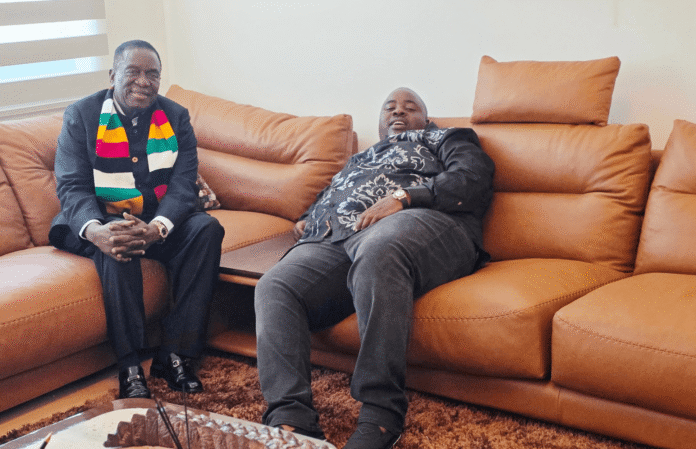
The year closed with a moment that symbolised reflection rather than spectacle. On New Year’s Day, Chivhayo shared on his X account that he paid a courtesy visit to Emmerson Mnangagwa at his rural home in Zvishavane, where the President was spending his annual official leave. The visit, described as informal, focused less on politics and more on leadership, gratitude and the road ahead.
According to Chivhayo, the President expressed deep appreciation for life and the responsibility of guiding the nation, while sharing optimism for 2026 as Zimbabwe enters the second phase of the National Development Strategy (NDS2), a key framework linked to the country’s long-term Vision 2030 goals.
What stood out was not the policy discussion but the presence. Despite being on leave, the President was surrounded by local elders, traditional leaders, and villagers from Mapanzure, who engaged him not as a distant figure of authority but as someone accessible and grounded in community life. It was a reminder that leadership is often measured in proximity, not pronouncements.
Chivhayo described the encounter as inspiring, noting the President’s reflections on his experiences in the liberation struggle and military training, which he linked to discipline, service and resilience. In those moments, leadership was framed not as power, but as responsibility, rooted in the understanding that authority ultimately comes from the people.
As Zimbabwe steps into 2026, debates around wealth, influence and political alignment will continue. But 2025 has also offered a quieter lesson, that generosity can exist beyond motive, leadership can be expressed outside formal platforms, and national conversations do not always need to be framed in absolutes.
For some, the year brought favour. For others, it demanded endurance. For the country as a whole, it served as a reminder that beyond politics and public scrutiny, humanity still has a place, and service, in its simplest form, still matters.