


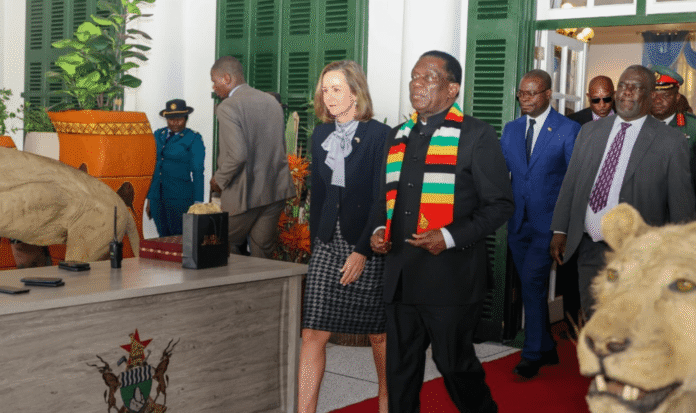
The United States has announced it will begin winding down health assistance to Zimbabwe after President Emmerson Mnangagwa ordered officials to halt negotiations over a proposed bilateral health agreement.
The decision carries immediate consequences. Around 1.2 million Zimbabweans currently receiving HIV treatment through US-supported programmes could be affected, unless the government moves quickly to secure alternative funding.
In a statement issued after reports of the breakdown in talks, US Ambassador Pamela Tremont confirmed the shift. “We will now turn to the difficult and regrettable task of winding down our health assistance in Zimbabwe,” she said.
For nearly two decades, the United States has been one of Zimbabwe’s largest health partners. Since 2006, it has provided more than $1.9 billion in support, helping the country reach the UNAIDS 95-95-95 targets, the global benchmark for diagnosing, treating and suppressing HIV.
At the centre of the dispute was a proposed Memorandum of Understanding under Washington’s America First Global Health Strategy. The agreement would have provided $367 million over five years for HIV treatment and prevention, tuberculosis, malaria, maternal and child health, and preparedness for disease outbreaks.
On 23 December 2025, however, Foreign Affairs Secretary Albert Chimbindi wrote to the ministries of finance and health, instructing them to stop all discussions on the president’s orders.
“The president has directed that Zimbabwe must discontinue any negotiation with the USA on the clearly lopsided MoU that blatantly compromises and undermines the sovereignty and independence of Zimbabwe as a country,” the letter said.
Zimbabwean officials argue the draft agreement was structurally unequal. According to diplomatic sources, President Mnangagwa objected to provisions granting the US access to national health data, including pathogen samples and epidemiological information. Officials described those requests as excessive and potentially compromising.
There were also concerns, though not formally documented, that the broader framework of cooperation indirectly touched on Zimbabwe’s strategic interests, including its mineral resources.
Washington rejects suggestions that the agreement compromised sovereignty. The US Embassy in Harare said the MoU was built on mutual accountability and co-investment, with Zimbabwe gradually increasing its own financial contribution to the health sector.
Ambassador Tremont stressed that point. “The United States has a responsibility to American taxpayers to invest their resources where mutual accountability, transparency, and shared commitment are assured,” she said.
US officials have also noted that 16 African countries have signed similar agreements, unlocking a combined $18.3 billion in health funding, $11.2 billion from Washington and $7.1 billion from recipient governments.
From Washington’s perspective, Zimbabwe’s decision runs counter to regional trends.
Harare, however, has framed the move as a matter of principle. Nick Mangwana, Secretary for Information, Publicity and Broadcasting Services, said the directive followed a careful review of the draft agreement. The government, he said, remains committed to protecting citizens’ welfare while safeguarding national sovereignty.
Officials argue that the MoU required Zimbabwe to share sensitive biological data without guarantees of reciprocal access to any resulting vaccines, treatments or diagnostics. In their view, a partnership must include equitable benefit-sharing, not simply financial support.
Zimbabwe has consistently supported multilateral approaches to global health governance. At recent World Health Organisation negotiations, it spoke on behalf of 50 African states, calling for pathogen data to be shared through the WHO’s Pathogen Access and Benefit-Sharing system. That framework aims to ensure that countries that contribute biological material benefit fairly from scientific advances.
Accepting a bilateral agreement outside that structure, officials argue, would weaken Africa’s collective position. Critics, however, question whether Zimbabwe can afford to lose such substantial funding. The country’s health system already faces financial strain, limited resources and competing budget pressures. The government has not yet outlined how it plans to replace the funding or transition patients to alternative support.
The disagreement also reflects broader shifts in global health diplomacy. Washington’s America First Global Health Strategy prioritises bilateral agreements and measurable accountability. Zimbabwe, by contrast, has emphasised multilateral solidarity.
Although the dispute centres on health, it occurs within a broader geopolitical context. Zimbabwe’s mineral resources, especially lithium and platinum-group metals, have attracted increasing international attention. While neither government has officially linked the health negotiations to resource access, diplomatic observers note that health cooperation and strategic interests often overlap.
For President Mnangagwa, ending negotiations reinforces a long-standing emphasis on sovereignty. Yet it also places immediate pressure on the national health budget. The decision amounts to a calculated gamble. It strengthens Zimbabwe’s claim to independent decision-making, but it leaves unanswered urgent practical questions.
Can Harare mobilise sufficient domestic resources? Will other partners step in to bridge the gap? And how smoothly can existing HIV treatment programmes transition without disruption?
Until clear answers emerge, patients and healthcare providers remain in limbo. For the United States, the move signals a recalibration of engagement based on accountability and policy alignment. For Zimbabwe, it represents a defence of sovereignty and a preference for multilateral frameworks.
The outcome will shape not only the future of HIV treatment in Zimbabwe, but also the broader direction of health diplomacy across Africa.