


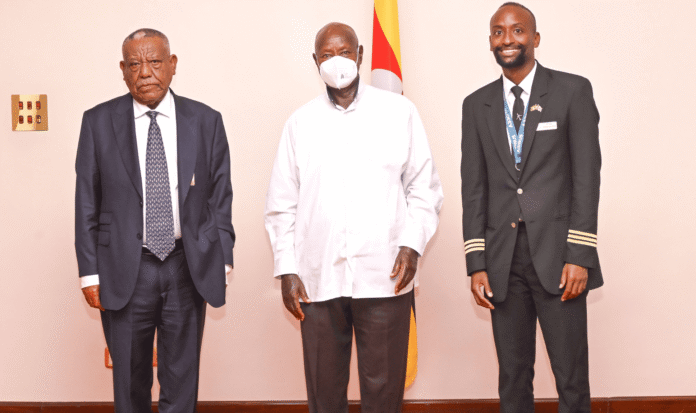
Kampala/Entebbe – President Yoweri Museveni has turned to one of Africa’s most respected aviation figures, Ethiopian Airlines veteran Girma Wake, to help steady Uganda Airlines transition as the government searches for a substantive chief executive. Analysts view the move as a decisive effort to restore professional management and governance at the struggling national carrier.
In a post on his X account on Wednesday, 4 February 2026, President Museveni said:
“I met Mr Girma Wake, the former CEO of Ethiopian Airlines, alongside Mr Robert Kateera at State House today. We discussed matters regarding air transport, among other issues.”
The meeting comes as Uganda Airlines advertises for a new chief executive following the exit of Jennifer Bamuturaki. Her tenure ended amid rising scrutiny over governance and management challenges at the airline.
Political commentator Andrew Mwenda described Wake’s involvement as a necessary corrective.
“Wake will help us manage the transition from the current corrupt and incompetent management to a new one,” Mwenda said. He added that Uganda Airlines needs “an entirely new administrative approach,” arguing that deep structural reform matters more than cosmetic leadership changes.
DON’T MISS THIS: Uganda Airlines CEO Resignation, Jennifer Bamuturaki Steps Down Amid Probe
Wake, 82, will serve as an interim executive and consultant. This comes despite the newly advertised CEO position setting a minimum age requirement of over 60 years.
According to sources, his role remains temporary and subject to vetting scheduled for next week. He is also expected to assist in identifying and recommending a substantive CEO.
Wake’s engagement arrives at a critical moment. Since its revival in 2019, Uganda Airlines has struggled to balance political expectations with commercial sustainability. The airline was designed to boost tourism, trade, and national prestige, supported by heavy state investment in aircraft such as Bombardier CRJ900s and Airbus A330-800neos. These assets aimed to position Entebbe as a regional aviation hub.
However, persistent losses and criticism over procurement, human resource management, and governance have weighed heavily on the carrier.
Auditor-General reports cited uncontrolled salary structures, missing staffing frameworks, and qualification gaps among senior officials. In addition, Bamuturaki’s tenure drew scrutiny from the Criminal Investigations Directorate and the State House Anti-Corruption Unit.
Aviation analysts say Uganda Airlines can draw critical lessons from Ethiopian Airlines, Africa’s largest and most profitable carrier.
Aviation management specialist Emma Okware highlighted effective leadership as central to Ethiopian Airlines’ success. He also pointed to investment in modern, fuel-efficient aircraft, which reduced operating costs and improved efficiency.
Okware further cited the airline’s pan-African network strategy, which expanded passenger traffic and strengthened continental dominance. He added that strong government support, paired with operational independence, allowed Ethiopian Airlines to make sound commercial decisions despite state ownership.
Wake’s Track Record in Governance Reform
Wake’s own record reinforces these lessons. As CEO of Ethiopian Airlines from 2004 to 2011, he oversaw fleet modernisation, strengthened the airline’s position in the Star Alliance, and introduced robust corporate governance systems insulated from political interference. These reforms helped transform the airline into a globally competitive and profitable enterprise.
Ethiopian Airlines has since earned repeated accolades, including “Best Airline in Africa,” and built a reputation for disciplined management and strategic expansion.
Sources say Wake is expected to assemble his own advisory team, even in his interim role. His mandate includes rebuilding confidence, restoring professionalism, and assessing staff qualifications before recommending a new management structure. As the Uganda Airlines transition unfolds, Wake’s involvement signals a serious attempt to impose commercial discipline, credibility, and long-term sustainability within Africa’s increasingly competitive aviation landscape.