
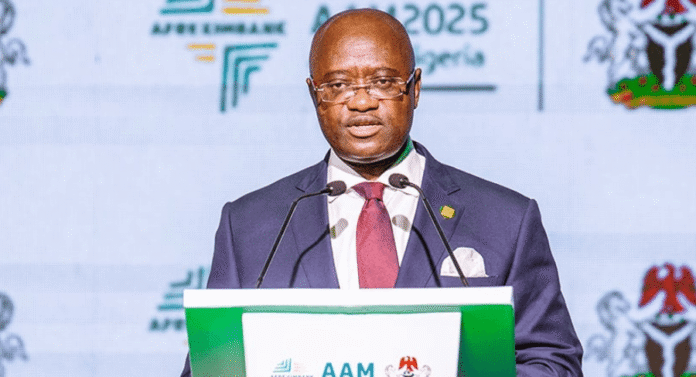
CAIRO, Egypt – Afreximbank President George Elombi has completed his first year leading one of Africa’s most influential trade finance institutions, with industrialisation, mineral processing and stronger intra-African trade at the centre of an ambitious agenda to transform the continent’s economy.
The African Export-Import Bank marked the anniversary on Sunday, recalling Elombi’s inauguration in Cairo on 25 October 2025, when he succeeded Professor Benedict Oramah as the institution’s fourth President and Chairman of the Board of Directors.
His appointment represented both continuity and a shift in emphasis. Having joined Afreximbank as a legal officer in 1996, the Cameroonian executive spent nearly three decades helping shape the institution before assuming its highest office.
His leadership now faces a challenge that has troubled African economies for generations: how to move beyond exporting raw materials and importing the finished products manufactured from them.
Africa holds substantial reserves of minerals, agricultural commodities and energy resources, yet much of the processing and manufacturing associated with those resources takes place elsewhere. The arrangement limits the economic value retained by producing countries and restricts opportunities to develop competitive industries.
Elombi has placed changing that structure at the centre of Afreximbank’s long-term strategy.
During his inauguration last year, he argued that Africa’s economic transformation would depend on producing more goods locally rather than relying on commodity exports.
“The structure of that trade is disfavourable to Africa. It has to change. It is too dependent on the export of commodities,” he said.
His message reflected a growing recognition among African policymakers that greater control over production and manufacturing is essential to creating jobs, strengthening domestic industries and reducing dependence on external markets.
Afreximbank’s proposed approach places particular emphasis on processing strategic minerals within Africa. Elombi has outlined plans for a dedicated financing window and a Strategic Minerals Development Programme supporting activities from extraction and refining to the manufacture of finished components.
The ambition is especially relevant to countries such as the Democratic Republic of Congo, Zambia, Zimbabwe and South Africa, whose mineral resources play an important role in global industrial supply chains.
Demand for minerals used in batteries, renewable energy systems and advanced manufacturing has increased the strategic importance of African producers. However, mineral wealth does not automatically translate into industrial development.
Processing facilities require reliable electricity, transport infrastructure, technical expertise and substantial investment. Without those foundations, resource-rich economies risk remaining suppliers of raw materials while higher-value manufacturing takes place overseas.
Elombi’s industrialisation strategy seeks to address that imbalance by linking trade finance with the development of regional value chains.
The African Continental Free Trade Area (AfCFTA) is another central component of the bank’s agenda. The agreement aims to create a more integrated African market, giving businesses opportunities to sell goods and services across national borders.
However, the existence of a continental trade agreement does not automatically remove the obstacles facing African exporters.
Businesses continue to encounter transport costs, customs delays, limited financing and difficulties accessing information about neighbouring markets. Smaller enterprises often face additional challenges when trying to expand beyond their domestic economies.
Afreximbank intends to strengthen support for these businesses through its Africa Trade Gateway digital ecosystem and programmes designed to improve access to market information, technical assistance and financing.
The bank has also continued promoting the Pan-African Payment and Settlement System, which is intended to make cross-border payments easier and reduce reliance on intermediary currencies in eligible transactions.
These initiatives reflect a broader effort to build the financial and commercial infrastructure needed to support African trade.
Elombi’s first year has also brought significant developments in the bank’s relationships with African governments.
In February 2026, South Africa formally strengthened its position within Afreximbank through accession to the institution’s establishment agreement as a sovereign shareholder.
The development was accompanied by an initial US$8 billion country programme intended to support industrialisation, infrastructure investment and deeper integration into regional markets.
Priority areas identified for the programme included mineral beneficiation, automotive manufacturing and energy infrastructure.
The financing commitment illustrates the scale of investment Afreximbank hopes to mobilise, although the announcement of a country programme should not be confused with completed disbursements or finished industrial projects.
The bank’s financial position provides another measure of its capacity to pursue these ambitions.
At the end of December 2025, Afreximbank reported total assets and contingencies exceeding US$48.5 billion, alongside shareholder funds of approximately US$8.4 billion.
Elombi has also outlined a much larger long-term ambition for the institution. During his inauguration, he disclosed a shareholder objective of expanding Afreximbank’s balance sheet to US$250 billion within ten years, while acknowledging an even more ambitious US$350 billion aspiration discussed with African leaders.
Such expansion would require substantial additional capital, careful risk management and sustained support from shareholders.
The targets remain ambitions rather than achieved financial results, but they demonstrate the scale of the bank’s intended role in Africa’s development.
Beyond industrial financing, Elombi has called for greater attention to the international financial architecture and the way African institutions are assessed by global markets.
The debate has intensified as African governments and development finance institutions question whether prevailing credit assessment frameworks adequately reflect the structure and mandates of regional lenders.
Access to affordable financing remains a major constraint on industrial development. High borrowing costs can make infrastructure and manufacturing projects difficult to finance, particularly when returns depend on long construction periods and uncertain market conditions.
Greater financial independence is therefore closely connected to the bank’s industrialisation agenda.
However, Afreximbank’s ability to deliver will depend on more than expanding its balance sheet. Governments must create conditions that encourage productive investment, improve infrastructure and provide predictable regulatory environments.
Industrial projects also need commercially viable markets, reliable supply chains and the skills required to operate increasingly sophisticated production facilities.
A year into Elombi’s presidency, these challenges remain substantial.
Afreximbank’s anniversary message has reaffirmed the importance of local processing, competitive industries and sustainable employment. Yet the longer-term test will be whether financing commitments translate into functioning factories, stronger African supply chains and measurable improvements in trade.
The institution’s influence extends across the continent, making its strategic direction relevant to governments, investors, manufacturers and small businesses seeking opportunities within Africa’s expanding market.
Elombi inherited an institution that had already established itself as an important financier of African trade. His challenge is to build on that foundation while advancing a more ambitious vision of economic transformation.
As Afreximbank enters the second year of his presidency, the central question is no longer simply how much Africa can export, but how much value the continent can create and retain before its products reach global markets.
The answer will help determine whether Africa’s natural resources become the foundation of a stronger industrial economy or continue to generate their greatest economic benefits elsewhere.