


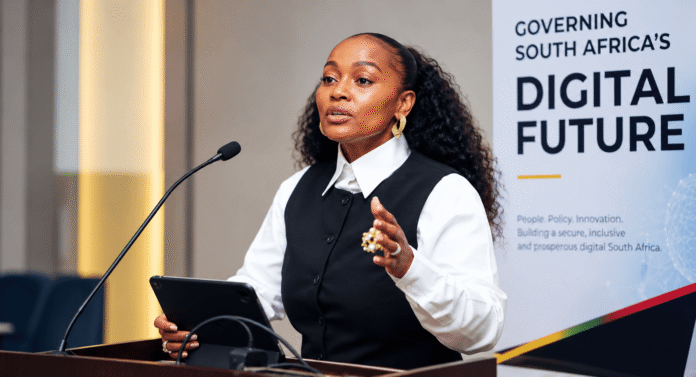
South Africa needs to put time, funding and effort into securing digital sovereignty for its own security, says Gijima Deputy CEO Roberta Gumede.
Digital sovereignty is the capacity of a country to exercise self-determination over its digital data, infrastructure, platforms and the rules that govern them.
Gijima is a 100% black-owned South African information and communications technology (ICT) company with Level 1 AAA+ B-BBEE status. The company brought more than 30 years of experience in providing ICT solutions to South Africa’s public and private sectors to the 2026 GovTech conference.
GovTech marked its 20th edition in Durban from 21 to 23 September 2026. “Digital sovereignty is a vital component of state security. It runs all the way from guarding against election interference to making sure our government is never so locked into infrastructure it doesn’t own or control that it can’t afford to change course,” Gumede said.
Under the theme “South Africa as Architect of its Digital Destiny for Citizens”, the 2026 programme shifted its focus from vision to execution. It placed greater emphasis on measurable delivery, institutional accountability, sovereign capability and outcomes that directly benefit citizens.
Gijima Chief Technology Officer Christo Abrahams said: “At GovTech, we bring the full digital sovereignty experience and OEM (original equipment manufacturer) experience to the vital conversation that must be had on how to fully secure South Africa’s capacity to develop, own and operate its own public service digital architecture.”
Gijima participated as a zettabyte sponsor of the conference.
Working with technology multinationals IBM and Huawei, Gijima helped build and implement the State Information Technology Agency’s (SITA) government cloud infrastructure. SITA owns and operates the government cloud. The infrastructure aims to consolidate government ICT systems and provide departments with a shared, secure platform.
In 2020, SITA appointed Gijima to implement and provide managed support for the Gauteng Department of Health’s (GDoH) integrated health information system. The core system is already operational. The department continues to roll out the full clinical and digital patient record system progressively, with further expansion expected through to around 2028.
“When the GDoH’s system is fully operational, the department will have a single view of each patient, across all the department’s entry points. The cost and time savings will be phenomenal. For example, blood tests won’t have to be replicated,” Abrahams said.
Abrahams says digital dependence on ICT companies based in other jurisdictions presents growing concerns. These range from security risks to reduced autonomy over financial and technology decisions.
Despite SITA’s government cloud system, many government departments have entered into separate software contracts. This is particularly the case at local municipality level and includes contracts with Western-based software companies.
As a result, some government data may sit on cloud systems using servers outside South Africa. Abrahams argues that bringing such information back into the country can be costly. Geopolitical tensions could create additional risks when critical data and infrastructure fall under another country’s jurisdiction.
Annual software licence renewals add another financial consideration. “You are paying in euros, dollars and yen and that goes into billions of rands, according to a report by the Industrial Development Corporation. The time to rectify this state of affairs is now,” Abrahams said.
“Gijima has the capacity and capability to help the government secure South Africa’s digital sovereignty. It’s only going to become harder and more expensive, financially and otherwise, to do.”