
LAGOS, NIGERIA – Dangote Petroleum Refinery is preparing for what could become Africa’s biggest-ever initial public offering, opening one of the continent’s most important industrial assets to public investors.
Nigeria’s Securities and Exchange Commission has approved the offering. Dangote plans to sell 4.1 billion shares at N525 each, potentially raising about N2.15 trillion, or US$1.6 billion. The order book is expected to open on September 14.
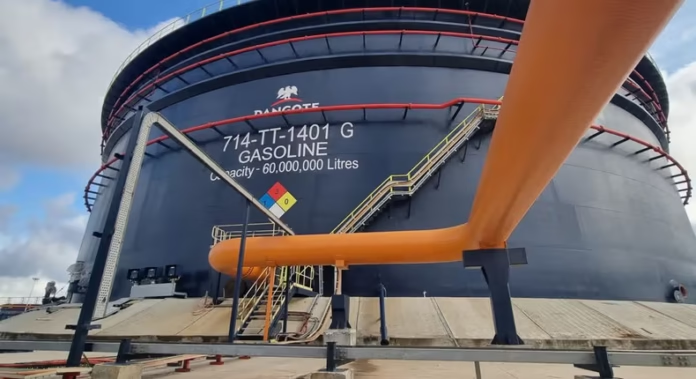
The listing represents a major milestone for the US$20 billion refinery in Lekki, near Lagos. With capacity of 650,000 barrels per day, the facility is Africa’s largest refinery and has already changed Nigeria’s fuel market.
The Dangote Refinery IPO also carries significance beyond Nigeria. A successful offer would bring one of Africa’s largest privately built industrial projects into public capital markets. It could also test whether African investors can help finance industrial expansion on this scale.
Aliko Dangote has emphasised African participation in the company’s next phase of growth. His refinery sits at the centre of Nigeria’s effort to reduce its historic dependence on imported petroleum products.
Nigeria spent decades exporting crude oil while importing large volumes of petrol and other fuels. Limited domestic refining capacity created that imbalance despite the country’s position as one of Africa’s biggest oil producers.
Dangote Refinery has started changing that equation. The facility produces fuel for Nigeria while also supplying refined petroleum products to international markets.
The IPO could provide fresh capital for an even larger expansion. Dangote wants to double capacity to about 1.4 million barrels per day, which would place the facility among the world’s largest refining complexes.
The transaction could also give investors a clearer market valuation for the privately held refinery. Current estimates value the business at about US$47 billion, although analysts have questioned how that figure compares with listed international refiners.
Investor demand will provide an important test of that valuation when the offer opens.
The listing follows regulatory concerns earlier this year. In June, Nigeria’s SEC warned market operators against promoting unauthorised pre-IPO offers linked to the refinery. At that stage, regulators had not approved a public offer.
The latest approval changes that position and gives investors access to an authorised transaction. That distinction will become increasingly important as interest builds around what could become a landmark African share sale.
Dangote’s ambitions also extend beyond the refinery. His group continues to expand its industrial footprint across Africa, while Dangote Cement has operations in several countries. Plans for further energy investments could deepen that continental presence.
The refinery IPO therefore represents more than a fundraising exercise for one Nigerian company. It could demonstrate whether African capital markets can mobilise large amounts of money for major industrial assets.
Africa faces a persistent infrastructure and industrial financing gap, even as pension funds, institutional investors and private wealth continue to grow across the continent. Successful transactions of this scale could create new pathways between African savings and African infrastructure.
When the Dangote Refinery IPO opens, investors will ultimately decide whether the valuation and growth strategy justify the price. The outcome could also reveal something bigger: whether Africa’s public markets are ready to finance a new generation of African industrial giants.