


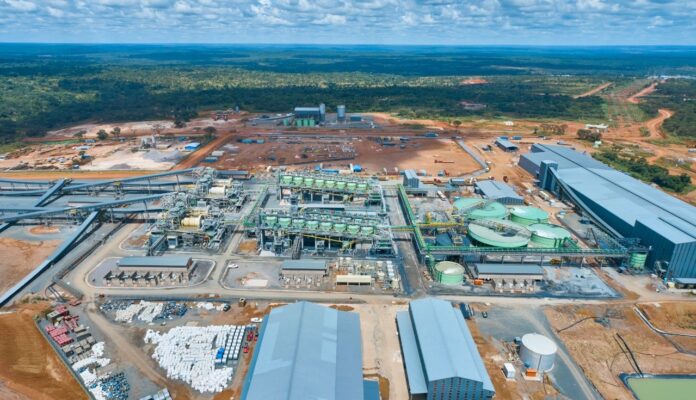
The Democratic Republic of the Congo has banned exports of copper and cobalt concentrates as Africa’s largest mining economies seek to retain more value from minerals that have become essential to the global energy transition.
The measure took immediate effect under a government order that replaces previous restrictions and exemptions. It requires mining companies to process more mineral output inside the country rather than exporting concentrates to overseas facilities.
The decision could strengthen the DRC’s efforts to build a larger domestic mineral-processing industry, although its immediate effect on global supplies may remain limited because much of the country’s copper already leaves as refined metal.
The DRC holds an extraordinary position in global mineral markets. It is the world’s largest cobalt producer and one of its biggest copper suppliers, giving decisions taken in Kinshasa significance across the electric vehicle, battery, renewable energy and electronics industries.
Cobalt plays an important role in several lithium-ion battery technologies, while copper remains essential to electricity networks, renewable energy infrastructure, electric vehicles and construction.
Global demand has made both minerals strategically important to governments and manufacturers seeking secure supplies during the energy transition.
The DRC has long argued that producing minerals alone should not define its role in those supply chains. Authorities want more processing and value addition to take place domestically so that mining generates greater investment, employment, tax revenue and industrial development.
The latest restrictions strengthen that approach.
The government order prohibits exports of copper and cobalt concentrates but allows authorities to grant waivers under specific strategic conditions. The policy therefore does not amount to a complete ban on exports of either metal.
That distinction matters because the DRC already processes much of its copper before export.
Official data cited by Reuters showed the country exported 696,725 tonnes of copper cathodes during the first quarter of 2026. It exported 53,926 tonnes of copper concentrates during the same period, containing 18,863 tonnes of copper metal.
Cobalt exports also include products that have undergone some processing. The country shipped 51,940 tonnes of cobalt hydroxides during the first quarter, containing 17,054 tonnes of cobalt metal.
These figures suggest the immediate impact on international copper supply could be smaller than the headline announcement initially implies. The longer-term importance lies in the direction of government policy and its implications for mining companies that still rely on concentrate exports.
One operation that could feel the impact is the Kamoa-Kakula copper complex, operated by Ivanhoe Mines and its partners. The project has previously exported some concentrate under exemptions while expanding processing capacity inside the country.
Mining companies affected by the new rules may now need to increase local processing, seek waivers or adjust existing supply arrangements.
The announcement quickly attracted attention in international commodity markets. Copper prices on the London Metal Exchange rose after news of the restrictions emerged, reflecting the DRC’s growing importance to global supply.
The country is already one of the world’s largest copper producers and dominates global cobalt production. Its mineral wealth has become increasingly important as governments compete to secure materials needed to electrify transport and expand renewable energy.
That global demand presents the DRC with an opportunity, but it also highlights a longstanding economic problem across Africa.
Many resource-rich African countries export minerals in relatively unprocessed forms before importing higher-value manufactured products. Much of the economic value created through refining, manufacturing and technology development therefore accrues outside the countries where the resources originate.
African governments have increasingly sought to change that model.
Zimbabwe has restricted exports of unprocessed lithium, while Namibia introduced controls covering several critical minerals. Other governments have also pursued policies designed to encourage domestic processing and mineral beneficiation.
The objective is straightforward: countries want mining to create industries rather than operate mainly as an extraction and export business.
Turning that ambition into a competitive industrial sector is more difficult.
Mineral processing requires reliable electricity, transport infrastructure, water, technical expertise and large amounts of capital. Weaknesses in any of these areas can make domestic processing more expensive than exporting material to established facilities elsewhere.
Electricity remains particularly important in the DRC.
The country has enormous hydropower potential, but mining operations in its southern copper belt have faced power constraints. Expanding processing capacity will require continued investment in generation and transmission infrastructure.
Companies must also determine whether the economics of building additional processing facilities justify the investment.
The government’s strategy suggests Kinshasa believes its mineral resources give it enough leverage to encourage that investment.
Cobalt provides the clearest example of that leverage.
The DRC accounts for roughly three-quarters of global cobalt production, giving it an influence over the market that few mineral-producing countries possess. Authorities have already used export controls and quotas to manage cobalt supply after prices came under pressure from global oversupply.
Copper presents a different market because production is spread across several major producing countries. The DRC has nevertheless emerged as the world’s second-largest copper producer, increasing its importance as demand rises.
The government has also introduced a new tax framework covering economically significant by-products produced through mining. The measures form part of a wider attempt to increase the economic value captured from the country’s mineral resources.
Greater domestic processing could create additional industrial jobs and stimulate investment in infrastructure and associated services. It could also strengthen the DRC’s position when negotiating with multinational mining companies and international partners.
The policy carries risks if processing capacity fails to expand quickly enough. Restrictions could create bottlenecks, increase costs or delay shipments at operations that cannot immediately process their entire production domestically.
A balance between industrial ambition and commercial competitiveness will therefore be important.
The policy also arrives as global powers compete more intensely over access to African critical minerals.
China already holds a powerful position within the DRC’s mining industry and dominates significant parts of the global battery supply chain. The United States and European countries have increasingly sought alternative partnerships as they attempt to diversify critical mineral supplies.
That competition gives mineral-producing African countries greater strategic importance.
The central question is whether governments can convert that geopolitical attention into lasting industrial development rather than another period dominated by raw material extraction.
The DRC’s latest decision points clearly towards local value addition. Instead of simply increasing the volume of minerals leaving the country, Kinshasa wants more of the economic activity between the mine and the finished product to take place within its borders.
Success will depend on what follows the export restrictions.
New processing plants, reliable electricity, skilled employment and stronger local supply chains would demonstrate that the policy is contributing to industrialisation. Restrictions without sufficient investment could instead increase costs without delivering the intended economic transformation.
The DRC possesses something the global economy increasingly needs. Its copper and cobalt sit near the centre of the transition towards electric transport, renewable power and greater electrification.
The country’s challenge is now to turn that geological advantage into broader economic value at home.
If the strategy succeeds, its significance could extend beyond Congo. It could strengthen a wider shift among African mineral producers seeking a larger share of the industries being built from resources extracted beneath African soil.