


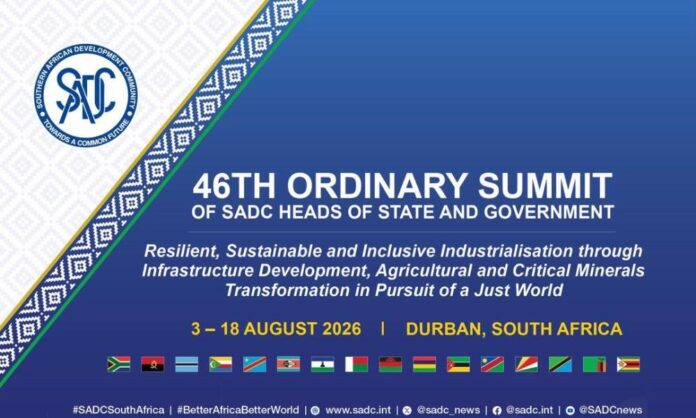
South Africa has begun taking a greater leadership role within the Southern African Development Community as the region prepares for a major summit in Durban focused on economic integration, industrialisation, energy and regional stability.
The 46th Ordinary Summit of SADC Heads of State and Government will take place at the Durban International Convention Centre on 17 August. Leaders from across Southern Africa are expected to assess the region’s economic and political priorities while considering how to accelerate integration among member states.
Preparations have already entered a key phase. South Africa formally assumed the chairship of the SADC Standing Committee of Senior Officials on 6 August, beginning a one-year term that will run until August 2027.
The committee plays an important role in coordinating SADC programmes and preparing recommendations that eventually reach ministers and regional leaders. Its work ahead of the Durban summit will help shape discussions at the highest level.
South Africa’s leadership comes at a significant moment for Southern Africa. The region continues to confront slow economic growth, high unemployment, energy shortages, climate pressures and security concerns, while governments seek greater regional trade and investment.
Economic integration is expected to remain central to the agenda. Despite decades of cooperation, trade between SADC countries still faces challenges linked to border delays, infrastructure gaps and differences in national regulations.
Regional leaders have repeatedly argued that Southern Africa must trade more with itself and build stronger production networks rather than depending heavily on exports of raw materials.
Industrialisation has therefore become one of SADC’s most important long-term priorities. The regional bloc wants member states to process more minerals and agricultural products locally, creating jobs and retaining a greater share of their economic value.
That ambition has become more urgent as global demand grows for minerals needed in electric vehicles, renewable energy and digital technologies.
Southern Africa holds some of the world’s most important mineral reserves, including copper, cobalt, lithium, platinum and manganese. Countries across the region increasingly want to move beyond extraction and develop industries capable of refining minerals and manufacturing higher-value products.
South Africa recently hosted the ninth SADC Industrialisation Week in Durban, where governments and businesses discussed investment, regional value chains and ways to strengthen manufacturing across the bloc.
Those discussions are expected to feed into the wider regional agenda as governments consider how industrialisation can support employment and economic resilience.
Agriculture will also remain important as countries confront changing weather patterns and recurring food insecurity. Droughts, floods and other climate-related events have affected agricultural production across several SADC states in recent years.
The region has identified agricultural transformation as essential to improving food security while reducing dependence on imported food. Greater investment in irrigation, technology, storage, transport and regional agricultural markets could help countries respond more effectively to climate pressures.
Energy presents another major challenge.
Several Southern African countries have struggled with electricity shortages that have affected households and businesses. Governments are investing in new generation capacity while exploring greater regional electricity trading through the Southern African Power Pool.
SADC has placed energy transition alongside industrialisation and agricultural transformation as a central part of its regional development agenda.
The challenge is particularly significant because Southern Africa needs more electricity to support industrial growth while also responding to global pressure to reduce carbon emissions.
Regional infrastructure will play a major role in determining whether those ambitions succeed. Roads, railways, ports, border posts and electricity networks connect national economies and determine how easily businesses can trade across borders.
South Africa occupies a particularly important position within that network. Its ports, financial institutions, manufacturing sector and transport infrastructure support trade across much of the region.
That economic weight gives Pretoria considerable influence within SADC, but it also creates expectations that South Africa will use its leadership to advance broader regional interests.
South Africa’s Minister of International Relations and Cooperation, Ronald Lamola, has emphasised deeper integration, sustainable development, peace and security as priorities as the country assumes greater responsibility within SADC structures.
The Durban summit will also take place against a complicated regional security backdrop.
Eastern Democratic Republic of the Congo remains unstable despite continued diplomatic efforts to address the conflict. Mozambique has also spent years confronting an insurgency in Cabo Delgado, while political transitions and electoral disputes periodically create tensions elsewhere in the region.
SADC has played a direct role in some of these crises through diplomatic engagement and military deployments.
Regional leaders now face questions about how SADC should respond to future security challenges while balancing peacekeeping commitments with limited financial resources.
Financing regional development has become another pressing issue.
Southern Africa needs significant investment in infrastructure, energy, industrial development and climate resilience. Governments are therefore considering ways to mobilise more domestic resources while attracting private capital and development finance.
The proposed SADC Regional Development Fund forms part of those efforts. The initiative aims to create a regional financing mechanism capable of supporting infrastructure and development programmes across member states.
Progress has been gradual, reflecting the wider difficulty of turning regional agreements into practical projects.
That implementation gap remains one of SADC’s biggest challenges.
The organisation has developed numerous protocols, strategies and regional programmes since its creation. Translating them into visible economic benefits for citizens has often proved more difficult.
Border delays continue to increase transport costs, infrastructure gaps restrict trade and businesses still encounter regulatory barriers when expanding across neighbouring markets.
Regional integration will therefore be judged increasingly by whether ordinary citizens and businesses can experience its benefits.
The African Continental Free Trade Area adds another dimension to that challenge. SADC countries now have an opportunity to connect their regional integration efforts with a wider continental market covering more than 50 African economies.
Southern Africa could benefit considerably if its manufacturers, farmers and service companies gain easier access to markets elsewhere on the continent.
Competition will also increase as businesses from other African regions seek opportunities within SADC markets.
The Durban summit gives regional leaders an opportunity to consider how Southern Africa positions itself within that changing continental economy.
South Africa’s leadership will carry particular significance. The country has Africa’s most industrialised economy and maintains extensive commercial relationships across the SADC region.
Its 12-month leadership period will coincide with growing pressure to accelerate infrastructure development, strengthen regional value chains and improve the movement of goods and services.
Success will depend on cooperation among all SADC members rather than South Africa alone.
The region includes economies of vastly different sizes and levels of development. Their priorities do not always align, while national interests can slow implementation of regional agreements.
Yet many of Southern Africa’s biggest challenges cannot be solved within national borders.
Energy networks cross countries, transport corridors connect landlocked economies to ports, rivers support several states and security crises can quickly affect neighbouring populations.
Economic integration therefore remains both an ambition and a practical necessity.
When regional leaders gather in Durban on 17 August, the significance of the summit will extend beyond speeches and declarations. The greater test will be whether SADC can translate its regional ambitions into investment, trade, jobs, reliable infrastructure and greater stability.
South Africa’s expanding leadership role gives Pretoria an opportunity to push that agenda forward as Southern Africa searches for a more integrated and resilient economic future.