


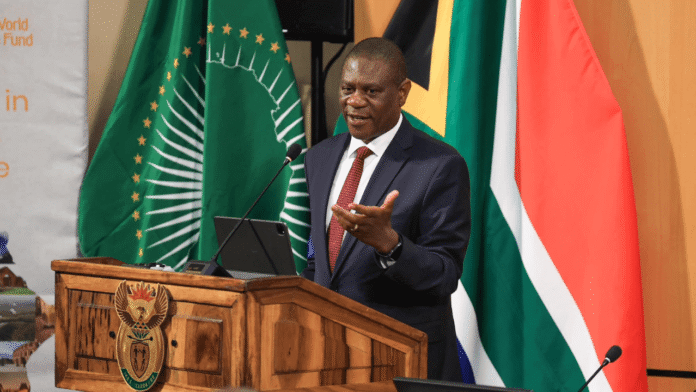
MIDRAND — Deputy President Paul Mashatile urged greater African ownership of the continent’s heritage. He declared, “Africa must fund its own heritage” at the African World Heritage Fund (AWHF) 20th anniversary event at the Development Bank of Southern Africa (DBSA) in Midrand on Tuesday.
The event marked two decades of sustainable investment in Africa’s heritage. Senior government officials, African Union representatives, UNESCO delegates, development finance institutions, civil society leaders, and heritage professionals from across the continent gathered for the occasion.
Mashatile, joined by Minister of Sport, Arts and Culture Gayton McKenzie, stressed that heritage is a dynamic asset central to Africa’s identity, unity, and economic future. He argued it is not a passive relic.
The Deputy President’s remarks signaled a shift in African leaders’ approach to cultural preservation. He noted that relying on external donors to maintain World Heritage Sites is unsustainable. This dependence undermines the continent’s agency.
Mashatile presented “Africa to fund its own heritage” as a policy directive. He urged governments, development finance institutions, and the private sector to become primary investors in heritage conservation. Minister McKenzie echoed this view, stating that heritage should be integrated into national development planning rather than treated as a peripheral issue.
“Heritage is an economic enabler,” McKenzie stated. “It creates jobs, attracts tourism, supports small businesses, and strengthens social cohesion. For inclusive and sustainable economic growth, we must invest in the assets that define who we are as Africans.” The joint emphasis from both leaders reflects growing political will to prioritise heritage within South Africa’s and the continent’s broader development agenda.
AWHF was established in 2006 through a partnership between the African Union and UNESCO. The South African government contributed an initial R20 million, with additional pledges from India and Israel. The Fund’s mandate is to address Africa’s underrepresentation on the UNESCO World Heritage List. It also aims to build African capacity to manage and protect heritage sites. Two decades later, AWHF has become the continent’s leading technical and financial mechanism for implementing the 1972 World Heritage Convention.
AWHF’s official records show the Fund has invested over USD 20 million in capacity-building programmes across Africa. These include training heritage managers, supporting World Heritage nominations, developing conservation management plans, and providing emergency response for sites threatened by conflict or natural disasters.
A key achievement of the Fund is the development of African heritage professionals. Before AWHF, many African states lacked the technical expertise to meet UNESCO’s nomination and reporting standards. Now, a growing network of trained African conservationists, archaeologists, and site managers leads protection efforts across the continent.
“Twenty years on, AWHF stands as proof that African institutions can endure, deliver impact, and shape global heritage narratives,” the Fund said in its anniversary statement.
Despite progress, Africa’s representation on the global heritage map remains limited. Of the 1,223 UNESCO World Heritage Sites worldwide, the continent has only 154 about 12%. This is despite Africa comprising 54 countries with significant cultural and natural diversity.
Nearly 30% of African World Heritage Sites are listed as “in danger.” These sites face threats from climate change, armed conflict, poaching, and rapid urbanisation. Nine African countries currently have no World Heritage Sites.
Speakers frequently cited these statistics during Tuesday’s proceedings as both a challenge and a call to action. AWHF Executive Director Dr Albino Jopela emphasised that safeguarding heritage amid environmental and geopolitical instability requires more than goodwill. It demands sustained financing, robust governance, and political recognition.
“Africa’s heritage is central to identity, unity, social cohesion, and economic development,” Dr Jopela said. “Protecting it requires long-term commitment.”
At the anniversary, the Fund announced a renewed focus on financial sustainability through its Endowment Fund. Established in recent years, the Endowment aims to create a permanent capital base to generate income for heritage projects independent of annual donor cycles.
This model follows global best practices from institutions such as the World Wildlife Fund and the Ford Foundation, which use endowments to provide predictable, long-term funding streams.
AWHF is engaging African governments, multilateral development banks, and private sector partners to expand the Endowment and reduce reliance on external grants. The goal is to ensure stable heritage protection, regardless of shifting donor priorities or budget cuts.
This approach aligns with the African Union’s Agenda 2063, which identifies culture and heritage as pillars of the “Africa We Want,” a vision for a prosperous continent based on inclusive growth and sustainable development.
The economic rationale for heritage was a recurring theme at the Midrand gathering. Both Mashatile and McKenzie emphasised that well-managed heritage sites can drive local economic development. This is especially vital in rural and peri-urban areas with high unemployment rates.
Globally, tourism linked to World Heritage Sites generates billions in revenue each year. In Africa, however, this potential remains largely unrealised due to limited investment in infrastructure, marketing, and community engagement.
“Heritage sites should not be fenced-off museums,” McKenzie said. “They should be active economic hubs where communities benefit directly through guiding, crafts, hospitality, and cultural entrepreneurship.” The Deputy President also noted that heritage can support post-conflict recovery and reconciliation, citing examples of cultural restoration that have helped rebuild social trust in communities affected by violence.
The 20th Anniversary marks a new beginning. AWHF has outlined an ambitious programme for 2026, including high-level engagements at the 39th African Union Summit in Addis Ababa and partnership dialogues with development finance institutions.
The Fund’s priorities for the next decade are clear. It aims to increase African representation on the World Heritage List through targeted technical support to underrepresented countries. Other goals include strengthening site resilience against climate change and conflict through adaptive management and early warning systems, mobilising domestic financing through the Endowment Fund and public-private partnerships, and integrating heritage into education to foster ownership among African youth.
“More than a celebration, AWHF@20 represents an opportunity to reflect on achievements, reaffirm commitment, and mobilise support for the next decade of impact,” the Fund stated.
The Midrand event also highlighted the importance of regional cooperation. African Union Commission representatives stressed that heritage protection requires coordinated policy and funding, especially for cross-border sites, shared cultural traditions, and regional tourism corridors.
UNESCO representatives welcomed the renewed African commitment and pledged ongoing technical support. They noted that global funding for heritage is increasingly competitive, highlighting the need for African self-reliance. As AWHF enters its third decade, its message is unequivocal: “Africa’s heritage is Africa’s wealth, and it is worth protecting.”
Deputy President Mashatile said the anniversary is an opportunity to turn rhetoric into tangible resources. Minister McKenzie sees it as a chance to integrate heritage into South Africa’s economic recovery plan. For AWHF, it is an opportunity to solidify its role as Africa’s heritage finance and technical hub.
The current challenge is to turn speeches into budgets, commitments into disbursements, and political will into measurable conservation outcomes. If these efforts succeed, Africa could safeguard more of its heritage over the next 20 years. The continent could then unlock its full potential as a source of identity, dignity, and prosperity.