


What a privilege to join the Fence Africa 24 family. Let’s get the introductions out of the way: I don’t just write about masculinity; I live in the trenches fighting for its restoration. I have experienced first-hand the impact of lost masculinity. I am Martin Pelders, founder of MatrixMen, the first organisation in Africa dedicated to supporting male survivors of sexual abuse.
I was born in Johannesburg. Though my parents immigrated here in the 1950s, my identity is rooted in Africa. Through my work, I have learned that, regardless of our backgrounds, men share similar wounds. My mission now tackles not just individual trauma but the broader challenges facing men today: fatherlessness, suicide, and the need for male advocacy.
Men today live in a world where we are told that we are toxic and trash, yet in the relationship, we are instructed to be the provider and protector. When we do step into our masculine roles, and it’s not what’s wanted, then we are told that we are terrible humans. So many men are adrift on an ocean of doubts, pushed to and fro by the tides of opinion.
Empowerment? Yes. For too long, men have been ignored. While the world pivoted, we remained wedged in cultural narratives that no longer served us.
People have been “peeing” on Africans for centuries, calling our customs “primitive.” “Backwards” and “Heathen”
The truth? Our original tribal structures were more nurturing and supportive of the family unit. The traditional African culture was centred around the fathers, and in my opinion, more psychologically sound than the fractured models imported from the West.
The Blueprint We Lost
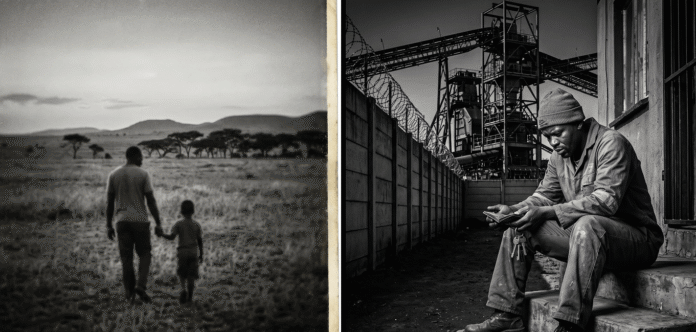
In the original African ideal, a father’s pride was his son. That son was mentored, supported, and encouraged from birth. They hunted side by side; they planted fields together. There was no “separation of spheres.” The village was a collective, a fortress of psychological safety. If a father fell in battle or on a hunt, the community didn’t just pity the family; they absorbed them.
Europeans lost this structure in the early 1800s during the Industrial Revolution. By the time they reached our shores to colonise, they were already entrenched in a broken way of life: Dad earned the money, and Mom was left alone to raise the children. When that became too difficult, children were shoved into the Prussian model of classrooms, a factory-style education that, to this day, fails boys; we simply aren’t wired to learn that way.
Boys are meant to be active and hands-on, yet we are confined to white uniforms, constricting lace-up shoes, and forced to sit behind desks to learn mentally rather than practically. When boys cannot sit still, parents receive a letter: “We suspect your son has ADHD; could you please take him to a doctor?” so he can be medicated. Boys must continually adapt to society, while society rarely adapts to their active, intelligent, boisterous, adventurous nature. Failures affecting our sons are widespread, spanning from the medical fraternity to the educational system.
The Theft of the African Man
For Africans, wealth was in cattle and kinship. We didn’t “own” land; we lived with it. Then came the fences. The colonialists didn’t just fence in the land; they fenced in the African soul. They replaced collective sustainability with cold, wire-bound ownership.
To feed the machine of “civilisation,” African men were hauled hundreds of miles away to work in mines. It wasn’t just labour; it was the calculated dismantling of the family unit. The oppressors knew, and still do, that if they can take the fathers away from their sons, they are weaker. To numb the pain of being used as slaves and the crushing loneliness of the compounds, men were fed cheap, potent spirits. This wasn’t an accident; it was a tool of compliance.
These lonely men, broken by the Migrant Labour System, found themselves in “shadow families” near the mines. Eventually, they became too ashamed to return to their original homes and families, so they left both. The burden of this European system was so overwhelming that many simply stopped participating in the raising of their children.
The Evidence on the Walls
This isn’t just a hypothesis. If you walk through the Workers’ Museum in Johannesburg, you will find a quote that confirms this cultural robbery:
“I hope my sons aren’t kept from their wives like their father was kept from their mother.”
This was the deliberate destruction of the African family. This was the target: the strong father. Slave traders and colonial powers knew then what we are forgetting now, a family supported by a firm, present father is almost impossible to conquer.
The Call to Arise
Today, the attack continues. Hollywood portrays fathers as bumbling idiots while “leadership” is stripped of its masculine essence. It is time, gentlemen, that we arise. I am not calling for “rage-filled” men, but for supportive, empowered, and aware fathers. Reclaiming our role as fathers is the heart of restoring masculinity. We must lead our homes as true masculine men, firm, unshakable, and present.
This is not a call to become dominating, angry men in your homes; this is a call to men to step up and be the three Ps in the home.
Protector: Not in the narrow sense of the word, but in the broader perspective, protect them mentally, spiritually and physically. Provider. It’s not just about food and a roof; it’s clothing, spiritual guidance, emotional strength, mental stability, and mentorship. The definitions we currently use are thin. Priest: You are the teacher, values, traditions, love, boundaries and in the African tradition, the storyteller, the guardian of the family history.
Remember, we aren’t playing on separate teams against women; we are partners. While we lead with protection and strength, we honour the woman’s role in leading the empathy and comfort of the home.
These core roles are not separated from us; if, for instance, the wife earns more, they should still remain. Men should lead the home in love, not fear, in wisdom, not anger. Let’s build better men. By reclaiming fatherhood and positive masculinity, we rebuild the village, the city, and the country. The world needs more masculine men, not less.