


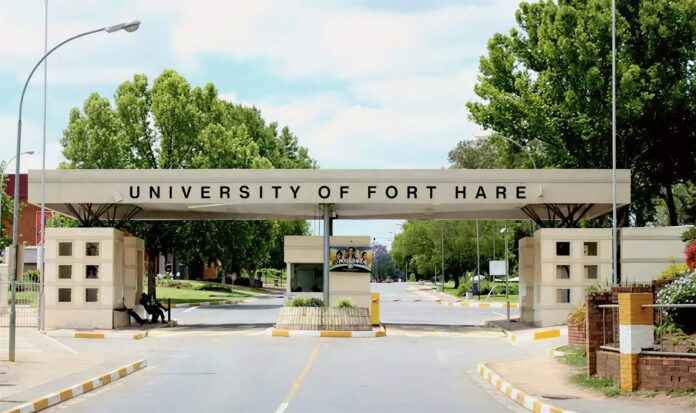
The University of Fort Hare is a historical epicentre of the African liberation movement. It shaped the political consciousness of leaders such as Nelson Mandela, Oliver Tambo, and Sir Seretse Khama. Today, however, that institution faces a governance crisis. This crisis risks compounding decades of decline.
The Cradle of a Continent
Long before “African liberation” had its current weight, a small college in Alice, Eastern Cape, was already doing consequential work for the continent. Founded in 1916 as the South African Native College, the University of Fort Hare was a radical proposition for its time. At a moment when colonial and later apartheid thinking held that Black Africans were intellectually inferior and undeserving of university education, Fort Hare offered an academic curriculum to Black, coloured, and Indian students. While Eurocentric in its foundations, it made no assumption of their inferiority, holding itself to the same academic standard as white institutions.
It was not mere charity. It was an ideological counter-statement to the prevailing racial order. Fort Hare cemented what the establishment refused to concede: Black African students deserved a university education and could excel at it. That this generation of scholars was overwhelmingly male speaks not to any limitation of Fort Hare’s vision but to exclusions of its era. It is a reminder of how many women were denied the same door.
Its classrooms became unlikely incubators of history. Here, Nelson Mandela, then a young man from Transkei, first met Oliver Tambo. That meeting would eventually seed the continent’s most significant liberation movement. Sir Seretse Khama, later Botswana’s founding president, was educated here. Desmond Tutu walked the grounds. Kenneth Kaunda, Charles Njonjo, Julius Nyerere, Robert Mugabe, Joshua Nkomo, the alumni roll call reads less like a register and more like a catalogue of those who shaped an entire continent.
Fort Hare produced more than graduates. It produced a generation that imagined a free Africa when such imagination was itself defiance. In 2024, the world formally recognised what history had long known. The University of Fort Hare was inscribed as a UNESCO World Heritage Site, the first African higher education institution to earn that distinction. The recognition was long overdue. Even as the world elevated Fort Hare, the institution battled for its soul. This crisis raises urgent questions about whether its custodians share the world’s high estimation.
When the Flame Was Targeted
Fort Hare’s success made it a force to be reckoned with and a target. By 1948, when the National Party came to power and began imposing apartheid, the college had already spent more than three decades proving Black intellectual thought was formidable. The apartheid government would not let this stand.
In 1959, through the Extension of University Education Act, the National Party stripped Fort Hare of its independence and converted it into an ethnic college exclusively for Xhosa-speaking students. Vocal staff members were dismissed, and a new administration, loyal to the apartheid regime, was installed. The institution that had produced statesmen and liberation architects was reduced, by deliberate government policy, to a tool of the very racial order it had spent decades defying.
Fort Hare had spent decades lighting a flame that apartheid could not afford to let burn. The response was not merely legislative; it was a deliberate extinguishing, a warning to an entire continent that the imagination of freedom came at a price.
Democracy in 1994 signalled the promise of restoration. For Fort Hare, this promise felt significant. The institution that apartheid tried to cage was now part of free South Africa. This brought the chance to reclaim its independence, diversity, and continental purpose.
Oliver Tambo had been expelled from Fort Hare more than fifty years earlier for confronting the administration. In 1991, he returned as its Chancellor. It was a moment of profound symbolic closure. The university that quietly seeded the liberation movement was being returned, at least in spirit, to those who sacrificed to keep that spirit alive. For a time, it seemed Fort Hare might rise again to meet the weight of its own legacy.
A War for the Soul of an Institution
The promise of renewal, however, has been hard to sustain. Since the advent of democracy, Fort Hare has struggled with institutional decline. Issues include underfunding, governance failures, and a creeping culture of corruption. These have gnawed at the foundations of one of Africa’s most important universities.
The signs of crisis have been visible for years. The university has been periodically paralysed by student protests that have disrupted academic proceedings and, at times, led to deaths among staff or students. In October 2025, several campus buildings were set on fire during unrest; these incidents are widely understood to have been direct responses to efforts to combat corruption within the institution. Several staff members lost their lives in this context. The violence has not been random; rather, it points to an ongoing conflict over who will shape the university’s future.
Vice-Chancellor Professor Sakhela Buhlungu is at the centre of this war. On 30 March 2026, the UFH Council suspended him after a forensic investigation revealed that he had appointed two executive directors without the required ratification by the council and the senate. The council, citing these appointment irregularities, unanimously agreed that disciplinary action was necessary.
The suspension is particularly contentious. When Buhlungu discovered the oversight, he alerted the council and sought correction. Insiders say the forensic report found no wrongdoing on his part. Despite this, the council proceeded. Those close to the situation say Buhlungu’s anti-corruption efforts made him a target of the very forces he opposed.
The human cost has extended beyond campus. In a letter dated 27 February 2026 to President Cyril Ramaphosa, Dr Beata Mtyingizana-Buhlungu, the Vice-Chancellor’s wife, described a three-year ordeal. It included medical collapse, financial ruin, disrupted children’s education, and a deep sense of abandonment by the state her husband tried to serve. It is a story that Fort Hare, of all places, should never have to tell.
A Familiar Capture
The current crisis at the university did not arrive without warning. Corruption, violence, and governance instability are not isolated incidents. They are chapters in a longer story of a post-liberation institution struggling to balance its historic purpose with present realities. This story resonates deeply across the continent.
Institutions once targeted by oppression are now often sites of a different capture. This capture is not racial, but political, financial, and class-driven. Mechanisms of control have evolved, but the effect is the same. Apartheid tried to control through law; corruption now does so through attrition, quietly hollowing out institutions that once embodied Africa’s highest aspirations.
For Fort Hare, the stakes are uniquely high. This is not just a governance dispute at a mid-sized South African university. It is a crisis in an institution that the world has formally recognised as a site of universal human heritage. Its existence once shook a government. Fort Hare produced statesmen who shaped generations and redrew Africa’s political map as a free continent. When corruption takes root in ordinary institutions, it is damaging. When it takes root at Fort Hare, it is closer to desecration.
Fort Hare has survived before. It withstood colonial condescension, apartheid laws, Bantustan isolation, and years of deliberate diminishment. With every blow, something essential endured: a spirit of resistance, a commitment to intellectual life, a belief in Africa’s sovereignty, and faith that its story is worth telling. That survival was not accidental. It resulted from people who knew what was at stake.
The question now is whether those people still exist in sufficient numbers and with the same spirit of resilience. Whether the continent that Fort Hare helped liberate is willing to turn its attention back to the institution that made that liberation imaginable. Whether South Africa, in particular, recognises that allowing Fort Hare to be hollowed out by corruption and political capture is not merely an administrative failure but a moral one.
A continent serious about its own renewal cannot afford to let the institutions that made that renewal possible fall into decay from within.
Fort Hare deserves more than a UNESCO inscription. It deserves the sustained, courageous, and uncorrupted stewardship that its history demands and its future deserves. The statesmen it produced did not imagine a free Africa, so that the institution that shaped them could be ransacked by the very forces they gave their lives to oppose.
The world has declared Fort Hare a site of universal human heritage. The harder declaration is the one Africa must now make for itself.
Editor’s note: The suspension of Vice-Chancellor Professor Sakhela Buhlungu is an ongoing matter. The disciplinary process had not concluded at the time of publication. This article reflects information available as of April 2026.