


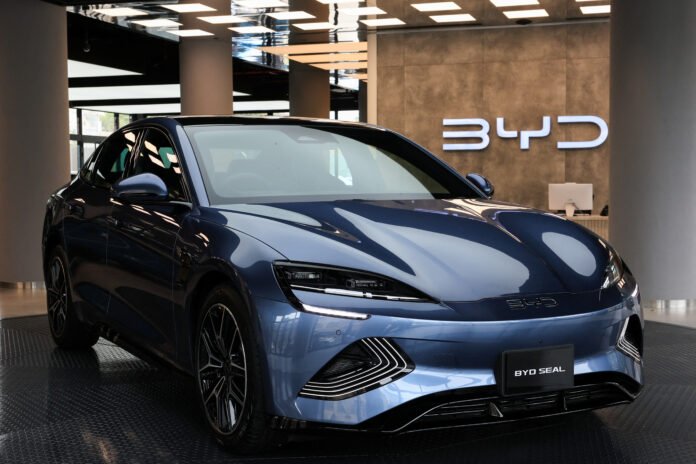
China’s leading electric carmaker BYD is on course to overtake Tesla as the world’s biggest seller of fully electric vehicles, signalling a major shift in the global EV market.
BYD delivered about 2.3 million battery-electric vehicles in 2025, according to industry estimates. That figure puts it ahead of Tesla, which is expected to end the year with roughly 1.6 million deliveries, marking a second consecutive annual decline for the US firm.
On the surface, the milestone underlines BYD’s rapid rise. Yet it also comes at a time when the Chinese group is facing slower growth at home as government support for electric-vehicle buyers begins to fade.
Slowing Growth at Home, Expansion Abroad
China’s decision to scale back EV subsidies has reshaped the market. Consumers are now more cautious, competition has intensified, and price pressure has increased. Domestic rivals such as Geely, Xiaomi, and Leapmotor are all fighting for market share.
As a result, BYD’s growth in 2025 was its slowest in five years. To maintain momentum, the company has turned increasingly to international markets. More than one million of its EVs were sold outside China last year, highlighting its growing global footprint across Europe, Southeast Asia, Latin America, and parts of Africa.
Tesla’s Bet on the Future
For Tesla, the challenge is not just competition in car sales but shifting investor expectations.
The company has already warned shareholders to expect further pressure on vehicle deliveries, with recent quarterly sales estimated to be around 15% lower year-on-year. Despite this, Tesla’s market valuation remains elevated.
That is because investors are placing less weight on current car sales and more on future technologies, particularly autonomous driving, robotaxis, and humanoid robots. Whether those ambitions translate into meaningful revenue remains an open question.
The Race Toward Driverless Technology
The contest between BYD and Tesla is unfolding alongside a broader push toward what industry analysts call “physical AI”, the integration of advanced software into real-world machines such as vehicles and robots.
In the United States, Waymo, owned by Google’s parent company, is already operating fully driverless taxi services in several cities. Zoox is also testing autonomous vehicles on public roads.
In China, companies including Baidu and Pony.ai have launched or expanded driverless transport services.
Tesla has said it aims to roll out fully autonomous robotaxis within the year. However, analysts note that regulatory approval, technical maturity, and safety performance remain significant hurdles to deploying such systems at scale.
A Market in Transition
BYD’s rise to the top of global EV sales reflects a changing industry, where manufacturing scale, pricing power, and international reach matter as much as brand recognition.
Tesla, meanwhile, is betting on a future shaped less by car sales alone and more by software-driven mobility. Which strategy ultimately proves more resilient will shape the next decade of the electric vehicle revolution.
For now, the race is no longer just about who sells the most cars, but about who defines what comes next.