


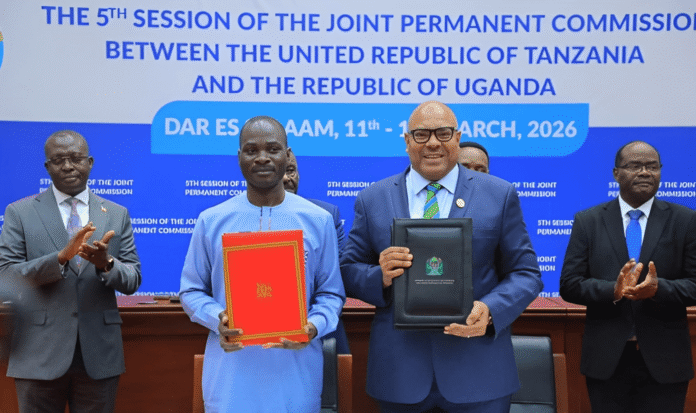
Uganda and Tanzania have signed a package of trade and transport agreements in Dar es Salaam, targeting two of East Africa’s most persistent economic obstacles, high transport costs and non-tariff barriers that drive up the cost and complexity of cross-border trade.
The centrepiece is a memorandum of understanding to jointly develop a cross-border Standard Gauge Railway linking western Uganda to Tanzania’s rail network and the Port of Dar es Salaam. The planned route runs from Isaka in north-western Tanzania, crosses into Uganda at Kikagati, and continues through Mbarara, Bihanga, and Kasese to Mpondwe on the border with the Democratic Republic of Congo.
The railway carries significant regional implications. Western Uganda gains reliable access to the Indian Ocean. Tanzania strengthens its position as a logistics hub. Eastern Congo, commercially important but poorly connected, gains proximity to an efficient export corridor.
The rail agreement was not the only outcome. At the 5th Session of the Uganda–Tanzania Joint Permanent Commission, both governments pledged to dismantle non-tariff barriers that have constrained cross-border business despite rising trade volumes. Both governments expect the measures to take effect in June 2026. Each has appointed focal points across relevant ministries, departments, and agencies to drive implementation.
East Africa’s deeper trade challenge has always been political will. Traders and logistics operators know border delays, inconsistent licensing, and transport bottlenecks all too well. What governments have struggled to deliver is the commitment to act. The Uganda-Tanzania agreements suggest both governments are now prepared to do so.
Uganda arrived at the talks with a clear agenda. Then Foreign Affairs Minister Jeje Odongo praised Tanzania’s railway progress and said improved SGR connectivity would cut transport costs and deepen economic ties. Trade figures underlined the urgency. Ugandan media reported a bilateral deficit of approximately UGX 9 trillion, a gap that both sides acknowledged needed to be closed.
The talks reflect a broader shift in how African governments approach bilateral negotiations. The agenda was grounded in specifics: infrastructure timelines, implementation mechanisms, and market access conditions. Neither government treated rail, port connectivity, and trade regulation as aspirational talking points. They formed the substance of the deal.
Implementation will be the real test. Agreements of this kind have stalled before. Both governments will face pressure to deliver on the June 2026 timeline. This package stands out with defined routes, named focal points, and a clear activation date.
The Uganda-Tanzania agreements represent one of the more substantive bilateral outcomes in East African trade diplomacy in recent years. The focus on freight routes, border reform, and measurable trade improvements gives the package practical weight.
If the railway advances and both governments dismantle the non-tariff barriers, the gains will extend well beyond Uganda and Tanzania. The broader East African corridor, and the businesses and communities that depend on it, stand to benefit.