


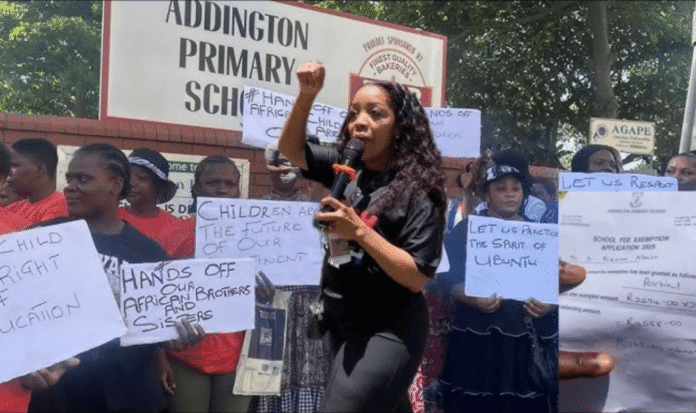
South Africa’s long-running immigration debate is entering a more troubling phase, as anti-immigration rhetoric increasingly spills into schools, clinics and neighbourhoods, raising serious questions about governance, legality and social cohesion.
Calls for tougher action against undocumented migrants have grown louder in recent months, led by activists such as Jacinta Ngobese‑Zuma and groups aligned to Operation Dudula, with political backing from Herman Mashaba. What began as protests against crime and pressure on public services has evolved into demands that foreign children, particularly from Zimbabwe and Nigeria, be removed from public schools to “make space” for South African pupils.
The argument put forward by activists is that overcrowded classrooms and strained public services are the result of unchecked migration. But critics warn that blaming migrants for systemic failures risks masking deeper governance problems, including poor planning, corruption and weak service delivery.
South Africa already has clear immigration laws and constitutional protections. The challenge has never been the absence of policy, but inconsistent enforcement and limited state capacity. Increasingly, however, some groups appear to be taking enforcement into their own hands. Reports of civilians stopping, searching or intimidating foreign nationals, disrupting workplaces, and confronting teachers and parents at schools have raised alarm among civil society organisations and legal experts.
Many warn that this represents a dangerous shift from lawful advocacy to vigilantism.
“This is not immigration control, it is social breakdown,” said one education sector official who asked not to be named. “Schools are becoming battlegrounds, and children are being used as political symbols.”
The situation has drawn uneasy comparisons to hard-line immigration enforcement seen elsewhere in the world, where aggressive tactics have led to accusations of abuse, racial profiling and excessive use of force. In South Africa’s case, the concern is that ordinary citizens are increasingly acting as de facto immigration officers, without training, accountability or legal authority.
For foreign nationals, the impact is immediate and personal. Parents fear sending their children to school. Workers worry about harassment at job sites. Communities that once co-existed are becoming polarised by suspicion and anger.
Yet economists and policy analysts point out that migration alone cannot explain South Africa’s deep structural challenges. The country faces long-standing issues of unemployment, failing municipalities, under-resourced schools and an overstretched health system, problems rooted in governance, not migration.
Targeting migrants may offer a sense of action, but it does little to address why schools are overcrowded, why clinics are underfunded, or why infrastructure continues to deteriorate.
South Africa’s Constitution is explicit about dignity, equality and the rule of law. Upholding those principles requires firm, lawful immigration management by the state, not intimidation by mobs, nor political rhetoric that blurs the line between policy debate and incitement.
As tensions rise, the question facing South Africa is no longer only about immigration. It is about whether the country can confront its governance failures honestly, without turning vulnerable communities into scapegoats, and whether the rule of law will be upheld by institutions, or surrendered to the street.
The choices made now will shape not only how South Africa manages migration, but how it defines itself as a constitutional democracy in a time of pressure.