
In March 2026, the Department of Communications and Digital Technologies (DCDT) submitted the draft National AI Policy to the Cabinet for approval and gazetting in South Africa. Now that it has been approved for gazetting, the draft AI Policy has been published and is open to public comment and consultation.
The policy is structured around six core pillars aimed at promoting the responsible development and deployment of AI. These core pillars are capacity and talent development; AI for inclusive growth and job creation; responsible governance; ethical and inclusive AI; cultural preservation and international integration; and human-centred deployment.
Because AI deployment and risk profiles differ across sectors, the policy recognises that a phased approach should be adopted across each sector. For example, enforcing comprehensive guardrails for AI would differ between a financial services corporation and a healthcare services corporation.
The DCDT has indicated that the policy aims to achieve outcomes such as improved public service delivery, expanded participation in the digital economy, and an enhanced quality of life for citizens.
Between 2020 and 2024, various foundations were established to govern the future use of AI in South Africa. In 2020, the Presidential Commission Report on the Fourth Industrial Revolution (PC4IR) was published.
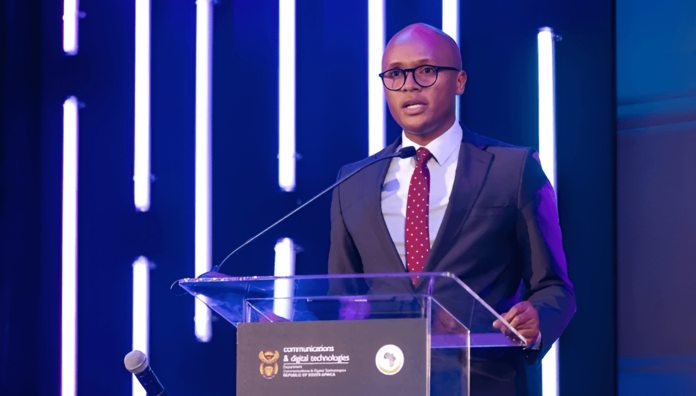
The regulation of AI itself in South Africa was first mentioned by DCDT Minister Solly Malatsi in November 2022. He said that the world’s leading policymakers were grappling with concerns such as misinformation, deepfakes, and disinformation, and that South Africa would also need to respond accordingly.
Between 2023 and 2024, AI Hubs were launched at the University of Johannesburg, Tshwane University of Technology, Central University of Technology, and Stellenbosch Military Academy to promote skills development and application-focused innovation.
In April 2024, at the University of Johannesburg, the draft National AI Plan discussion document was launched. As a result, the AI Policy Framework was published in August 2024. Following this, the Socio-Economic Impact Assessment System (SEIAS) certification was granted for the draft AI Policy.
After the current 60-day consultation period, the draft will be submitted to Cabinet once more for final approval of the National AI Policy. It is then expected to move into the implementation stage later in 2027 or 2028.
The DCDT says that the proposed rollout schedule includes alignment with existing data protection and cybersecurity frameworks, collaboration with industry, academia, and civil society, followed by phased adoption across priority sectors.
Baker McKenzie, a leading law firm in the country, says AI governance will likely overlap with existing regulatory obligations, including conduct, risk management, data protection, and cybersecurity, embedding accountability within current frameworks. Instead of creating a single AI regulator, oversight will be distributed among existing authorities and legislation.
Existing laws that regulate the processing, monitoring, storage, and other uses of data, as well as data governance, include the Protection of Personal Information Act, the Consumer Protection Act, the Cybercrimes Act, the Copyright Act, the Patents Act, the Electronic Communications Act, and the Electronic Communications and Transactions Act.
In embedding AI-related clauses into these laws, the University of Johannesburg discussion draft noted the integration of international best practices on the regulation of AI. These include the OECD on the regulation of artificial intelligence, the UNESCO General Conference on the regulation of artificial intelligence, the G7 Hiroshima AI Process Comprehensive Policy Framework on the regulation of artificial intelligence, the Council of Europe AI Convention, the Malabo Convention on the regulation of AI, and the EU AI Act.
What began with the Presidential Commission on the Fourth Industrial Revolution in 2020 has evolved through a series of milestones, including the launch of AI Hubs across universities in 2023 and 2024, and the pivotal April 2024 draft.
As the 60-day window for public comment remains open, the focus now shifts from government to the citizenry, helping ensure that the final policy for 2028 becomes a social contract for a human-centred digital future.
Employers should begin developing workplace-specific AI policies, if they have not already done so, to align with South Africa’s evolving national approach to responsible and ethical AI use. This includes mapping data flows, assessing model explainability, and evaluating alignment with existing governance frameworks and recommendations, such as those under King V, as well as obligations under existing regulations such as POPIA.