


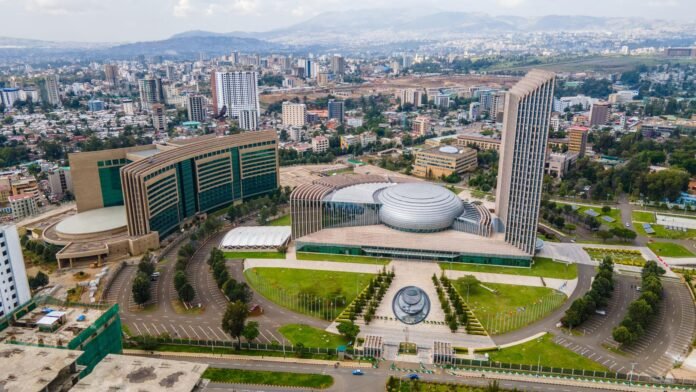
Addis Ababa – Ethiopia Reuters accreditation became a flashpoint ahead of the 39th African Union Summit after Addis Ababa declined to renew credentials for three journalists and withdrew the agency’s summit access. The decision has reignited debate about sovereignty, press freedom and who controls Africa’s global narrative.
For decades, much of the continent’s global image has been shaped in newsrooms far from its borders. Conflict dominates headlines. Political turbulence leads bulletins. Economic or technological gains tend to arrive as secondary notes, often accompanied by cautionary caveats.
That pattern has resurfaced in recent days in Ethiopia. The government in Addis Ababa declined to renew accreditation for three Reuters journalists based in the capital and withdrew the agency’s access to cover the 39th African Union Summit. The move followed a Reuters investigation alleging that Ethiopia hosts a training facility linked to Sudan’s Rapid Support Forces.
Reuters has said it stands by its reporting and will continue covering Ethiopia according to its editorial standards. Ethiopian authorities have not publicly detailed their reasoning beyond the decision itself.
The episode has reignited a wider debate: when African governments restrict foreign media access, is it suppression, or an assertion of sovereignty?
Every country regulates media accreditation in some form. Western governments have, at various times, limited or revoked journalist access on grounds of national security or procedural compliance. Such actions are usually treated as administrative matters.
Why Ethiopia Reuters Accreditation Matters Beyond Addis Ababa
In Africa, similar decisions often attract sharper scrutiny. Ethiopia’s reaction comes at a delicate moment. The country remains a central diplomatic hub, hosting the African Union headquarters. It is managing regional tensions in the Horn of Africa while advancing domestic reforms and infrastructure ambitions, including the Grand Ethiopian Renaissance Dam, a project Addis Ababa sees as a symbol of energy sovereignty and economic independence.
The Reuters report, which cited unnamed diplomatic and security sources, acknowledged that it could not independently verify key elements of its claims. The United Arab Emirates, mentioned in the report, denied involvement. Ethiopian officials have not confirmed the existence of the alleged facility.
Yet the allegations travelled widely and quickly. For some in Addis Ababa, the issue is less about a single report and more about a cumulative narrative. Ethiopian officials and commentators argue that international coverage often foregrounds instability while underplaying development or diplomatic initiatives. They say stories about Africa frequently begin with suspicion rather than context.
Critics, however, warn that restricting access to foreign journalists risks reinforcing perceptions of opacity. Independent reporting, they argue, remains essential for accountability, particularly in regions marked by conflict.
The tension is not new. Across the continent, governments have at times clashed with international news organisations. Ghana, Kenya and South Africa have all challenged global credit rating agencies over perceived bias. Nigeria and others have objected to external portrayals of domestic security matters.
The underlying question runs deeper than a single accreditation dispute: who defines Africa’s narrative as it evolves?
African journalism itself has expanded rapidly in recent years, with stronger investigative platforms, digital newsrooms and cross-border collaborations. Advocates say the solution lies not in shutting out international media, but in strengthening local capacity to report rigorously and independently from within the continent.
There is also a broader geopolitical dimension. As Africa’s economic and strategic importance grows from critical minerals to renewable energy corridors, global attention has intensified. With that attention comes contestation over framing.
Ethiopia’s decision, controversial as it may be, reflects a growing assertiveness among African states. Leaders increasingly speak of “narrative sovereignty”, the idea that nations should not merely be subjects of global storytelling but active authors of it.
The challenge is balance. Governments have the right to regulate access to the media. Journalists have the responsibility to investigate power. Where those principles collide, trust becomes fragile.
Africa’s rise is not a slogan but a complex process, marked by reform, conflict, ambition and contradiction. Telling that story requires nuance and, perhaps above all, context.
As Ethiopia hosts continental leaders and navigates regional tensions, the debate over who tells Africa’s story may prove as significant as the story itself.