


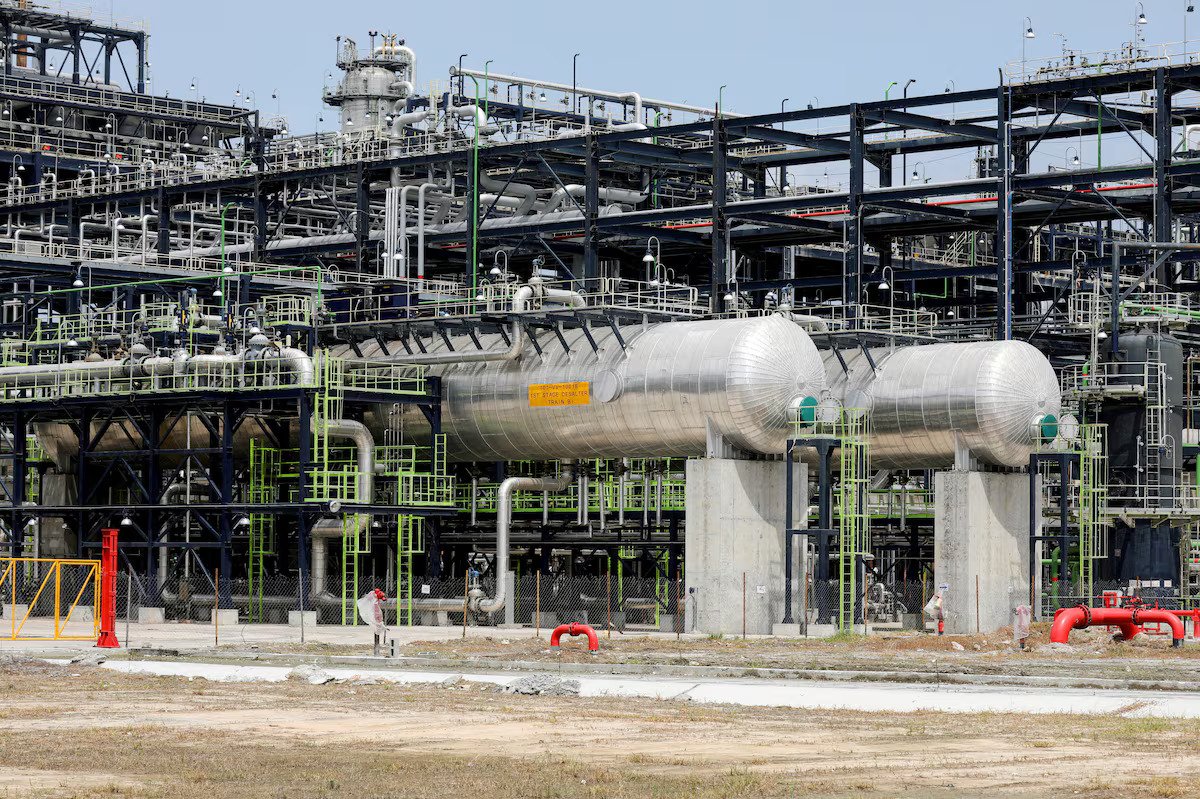
The Dangote oil refinery in Nigeria, owned by Africa’s wealthiest businessman, Aliko Dangote, has officially begun distributing petroleum products to the local market, marking a historic milestone in the country’s long-standing pursuit of energy self-sufficiency. The first domestic shipments, which commenced on Tuesday, signal the start of what many analysts see as a transformative shift for Nigeria’s energy sector and broader economy.
Constructed on the outskirts of Lagos at an estimated cost of $20 billion, the Dangote refinery is the largest single-train refinery in the world and the largest in Africa and Europe. With a refining capacity of up to 650,000 barrels per day (bpd), the facility is designed to process a wide range of crude oil grades and produce refined petroleum products including petrol, diesel, jet fuel, and other derivatives. According to the company, the refinery is expected to reach full operational capacity either later this year or in early 2026.
Group Executive Devakumar Edwin confirmed that diesel and jet fuel are the first products being supplied to the domestic market. He noted that the refinery is already operating at a scale that allows for the loading of ships with millions of litres of fuel, both for domestic consumption and for export. Products are being distributed via both marine and road logistics, a dual-channel approach that significantly strengthens Nigeria’s fuel supply infrastructure.
Dangote Oil Refinery is redefining the petroleum landscape on the African continent
“The volumes we are handling are substantial,” Edwin said, adding that the refinery’s logistics systems have been designed to minimise bottlenecks and ensure steady supply to marketers and distributors across the country. The ability to load large vessels directly from the refinery is expected to reduce congestion at ports and lower transportation costs, which have historically contributed to higher fuel prices.
Market response to the refinery’s launch has been swift. The Independent Petroleum Marketers Association of Nigeria (IPMAN) and the Depots and Petroleum Products Marketers Association of Nigeria (DAPPMA) have both entered discussions to secure supply agreements. IPMAN, which represents operators controlling an estimated 150,000 retail fuel stations nationwide, plays a critical role in fuel distribution, particularly in rural and peri-urban areas. DAPPMA, which represents depot owners and major marketers, is reportedly in the process of arranging letters of credit to facilitate large-scale procurement from the refinery.
DONT MISS THIS: Dangote Fertiliser Mega-Plant Drives Africa’s Industrial Self-Reliance
The integration of Dangote’s output into Nigeria’s fuel supply chain is expected to reshape the market dynamics. For decades, Nigeria has faced the paradox of being Africa’s largest crude oil producer while relying heavily on imported refined petroleum products. Chronic underinvestment, mismanagement, and repeated delays in rehabilitating state-owned refineries have left the country dependent on imports, exposing it to foreign exchange pressures and global price volatility.
The Dangote refinery has the potential to reverse this trend. By significantly reducing fuel imports, Nigeria could save billions of dollars annually in foreign exchange, strengthen its balance of payments, and stabilise domestic fuel supply. In addition, the refinery is expected to create thousands of direct and indirect jobs, stimulate local industries, and enhance energy security.
Beyond Nigeria, the refinery could also play a strategic role in supplying refined products to West Africa and other regional markets, positioning the country as a net exporter of petroleum products for the first time in decades. As production ramps up, the Dangote refinery stands as one of the most ambitious industrial projects on the continent, with the capacity to redefine Nigeria’s place in the global energy value chain.