


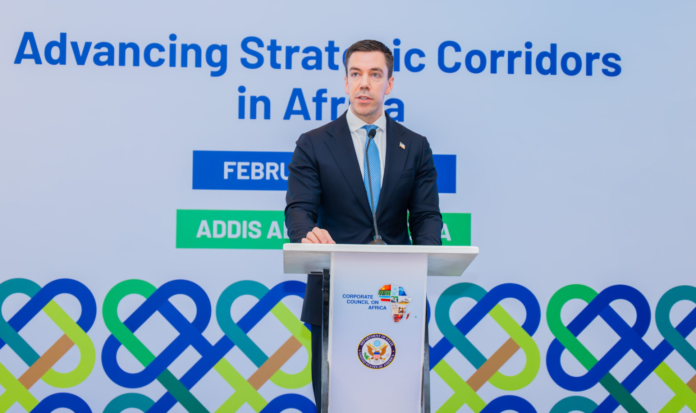
The Trump administration has now given its clearest statement on how it wants to engage Africa. It calls the approach “America First in Africa.”
Nick Checker, the new head of the US State Department’s Africa Bureau, presented the framework in Washington. He described the address as his “first time speaking publicly on our broad Africa policy.” His remarks set out a doctrine that places trade, strategic interests and transactional partnerships at the centre of Washington’s approach to the continent.
The new policy rests on three pillars. The first is commercial diplomacy. Under this approach, the US will build its engagement with Africa around trade and private investment, not traditional aid-led relationships. The stated objective is to both “increase US exports & investment in Africa” and “harness Africa’s abundant natural resources.”
Critical minerals sit near the centre of that agenda. Infrastructure investment, logistics and processing capacity will also feature strongly. Washington wants to secure strategic supply chains and deepen its commercial footprint on the continent.
Checker pointed to the DRC-US Strategic Partnership Agreement, the Washington Accords and the Lobito Corridor as examples of this model. Defending the shift, he said: “Every African leader I’ve met with loves this new approach because American companies strengthen economic sovereignty rather than undermine it.”
The second pillar concerns foreign assistance. Under the new model, the administration no longer presents aid as charity. Instead, it describes aid as “strategic capital.” It ties that assistance more directly to US interests and to the expectation that African countries become less dependent over time.
Checker said the purpose of foreign assistance would be to advance US interests while helping African states become “more self-reliant.” He described the shift in striking terms. “African governments love these agreements because they offer ownership and empowerment. This approach moves from an infantilizing NGO industrial complex to one that treats Africans as capable partners.”
The third pillar focuses on conflict resolution. Here, the administration’s language marks a sharper break from the democracy and governance emphasis that shaped much of Washington’s earlier engagement with Africa. Under this doctrine, the US sees itself more as a broker of deals than as a promoter of democratic norms.
Checker made that position explicit. “Lecturing on democratic norms amid complex local realities is ineffective,” he said. He added that the United States would also be “tolerat[e] instability where US interests are not directly implicated.”
Taken together, the policy marks a clear departure from the values-based and institution-building approach that shaped much of previous US engagement on the continent. In its place, Washington has adopted a more openly transactional doctrine. That doctrine seeks measurable returns in trade, minerals, influence and strategic alignment.
Checker argued that this does not put American priorities at odds with African ones. “America First is wholly compatible with Africa First,” he said.
There are areas where US and African interests may align, especially in infrastructure, trade, industrial growth and energy transition supply chains. Recent reporting, however, has also raised concerns about what happens when those interests diverge. Critics pointed last week to the Zambia case, where reports said HIV treatment support had been linked to minerals access. That case has already fuelled debate over how this doctrine could operate when power is uneven and strategic resources are involved.
For African governments, investors and business leaders, Washington’s message is now much harder to misread. The administration has made clear that its primary reference point is American interest, not Africa’s development needs.
That does not mean the policy will always work against African priorities. In some areas, the overlap may be substantial. In others, the gap may be sharp.
What matters now is clarity. Those engaging the United States will need to understand where interests genuinely converge, where they do not, and how to negotiate accordingly.