


As the race for critical minerals in Africa continues, there is no denying that another related race is unfolding alongside it: the race to dominate electric vehicles, EV charging networks and mass EV adoption. The world is no longer competing only over the minerals that power the transition.
It is also competing over who builds the systems, habits and infrastructure that will define how that transition works in everyday life. Africa is part of that shift too, not only as a source of critical minerals, but as a growing market in the wider EV adoption story.
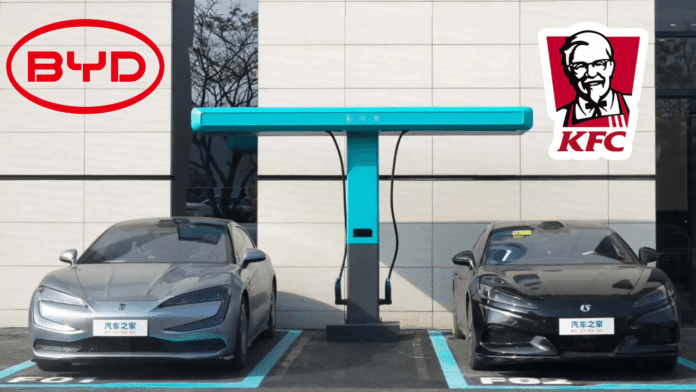
That is why BYD’s reported collaboration with KFC China has drawn attention. It points to a simple idea. The EV race is moving beyond the car itself. It is now about speed, convenience and whether charging can fit naturally into daily routines.
Recent reports suggest that BYD and KFC China may be working on ultra-fast charging sites linked to restaurant locations. The idea is to let drivers combine charging with a short food stop. I could not verify that partnership through an official Yum China or KFC China statement in the sources previously reviewed. It is therefore safer to describe it as a reported tie-up, not a confirmed rollout. What is clear is that BYD is pushing hard on fast charging.
In March, the company unveiled its Flash Charging platform. It said compatible batteries could move from 10% to 97% in nine minutes. BYD also said the system could deliver charging power of up to 1,500 kilowatts. That places it among the fastest charging platforms now being promoted in the industry.
That matters because one of the biggest questions in EV adoption is still practical. Drivers want to know not only how far a car can travel. They also want to know how quickly it can get back on the road. If charging can happen during a meal or a brief stop, one of the biggest psychological barriers to EV use begins to weaken.
BYD has also made clear that this is not a small trial. The company plans to build 20,000 Flash charging stations across China by the end of 2026. That target shows how serious it is about controlling more of the charging experience, not just the vehicle sale.
This is where the reported KFC angle becomes commercially interesting. Fast food chains already work around short dwell times, predictable customer flow and easy access. EV charging operators want those same conditions. Put the two together, and the charging stop becomes less of a disruption and more of a routine part of modern mobility.
BYD is also trying to address the infrastructure challenge behind ultra-fast charging. The company has said its charging sites will include energy storage systems. That could help reduce pressure on the grid when large amounts of electricity are delivered quickly. This matters because very fast charging is not only a battery issue. It is also a power management issue.
For the wider EV market, the lesson is straightforward. The next stage of competition will not be decided only by who builds the cheapest car or the biggest battery. It will also depend on who makes charging easiest to live with.
That is why this matters beyond China. As the global race for EV adoption accelerates, countries and companies are learning that convenience may matter as much as technology. Africa will increasingly feel that shift too, both as a minerals base and as a future EV market.