


For decades, Africa occupied a familiar place in the oil economy. The continent exported crude, imported refined fuel and lost much of the real value in between.
Dangote’s recent jet fuel shipment to Europe shows that African refining capacity is starting to matter in a market under pressure. The cargo to the United Kingdom came as fuel buyers searched for alternatives amid disruption linked to conflict in the Middle East and mounting concern over established supply routes.
Europe’s fuel market has faced renewed strain as the conflict involving Iran unsettles energy flows and raises pressure around the Strait of Hormuz, one of the world’s most important oil transit corridors. Buyers have had to widen their options as supply risks and market uncertainty grow.
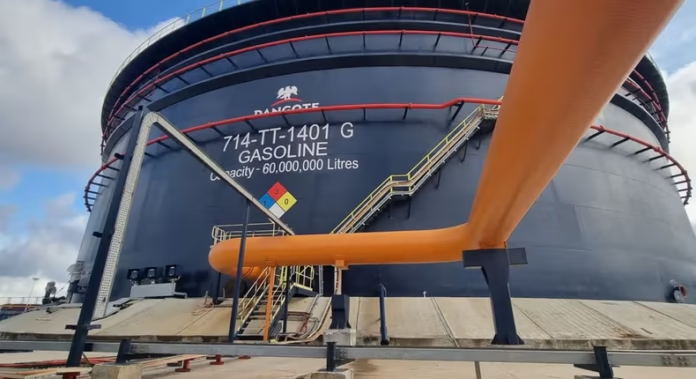
Dangote’s refinery has entered that space with growing weight. With a nameplate capacity of 650,000 barrels per day, Dangote built the refinery to change Nigeria’s fuel balance and reduce the country’s dependence on imported refined products. Its relevance now extends further. Recent export activity shows the plant supplying African markets while also meeting demand beyond the continent when conditions tighten.
In March, Dangote exported about 456,000 tonnes of refined petroleum products to African countries, including Ghana, Togo, Cameroon, Côte d’Ivoire, and Tanzania. That growing regional reach had already established the refinery as an important new force in the African fuel trade. The jet fuel shipment to Europe puts that story in a broader market context.
Fuel buyers do not shift because of symbolism. They shift because they need dependable supply, workable routes, and fewer points of geopolitical risk. Nigeria’s Atlantic location, Dangote’s scale, and the refinery’s rising output have made it a more credible option in a market where traditional assumptions no longer hold.
For Africa, the deeper significance lies in the changes that refining brings. A project of this size does more than process oil. It changes where margins are earned, where logistics power gathers and where downstream value stays.
When refined fuel leaves an African refinery for African and European markets, more of the commercial upside stays closer to the continent. That shifts jobs, trade balances, and industrial confidence. It also strengthens Africa’s broader effort to capture more value from its own resources.
The shipment also sharpens a larger point about Africa’s place in the world economy. For years, global markets treated the continent mainly as a source of raw inputs. Dangote’s exports suggest a more assertive position, one in which Africa processes more of what it produces and reaches global markets with greater control over the finished product.
That does not mean the old vulnerabilities have gone. Running a refinery at this scale in a volatile market brings real pressures across crude sourcing, pricing, and operations. One cargo to Europe does not redraw the global energy map overnight.
But it does show something important. When supply tightened and buyers needed options, attention turned to Nigeria. That is a meaningful shift. It suggests Africa is no longer confined to the upstream end of the story. In moments of global strain, it is beginning to matter downstream too.