


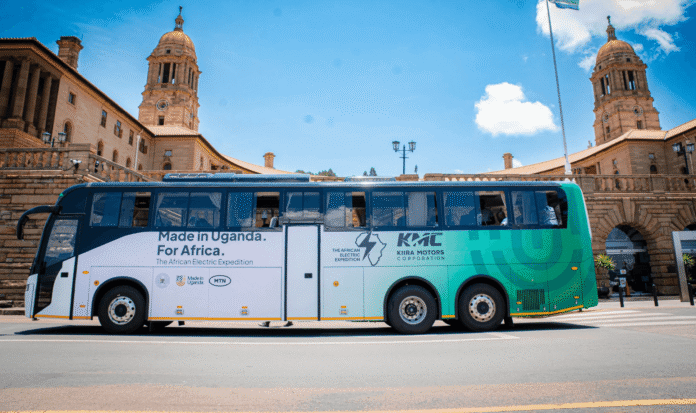
A deal involving Ugandan-made electric buses and the South African market is drawing attention well beyond the transport sector. It points to something larger. It offers a glimpse of what the African Continental Free Trade Area could become when African countries trade high-value industrial goods, not only raw materials.
Reports in early March said Kiira Motors Corporation secured a deal worth about $250 million linked to South Africa. Other reporting suggests the wider commercial pipeline stands at 820 buses, with 450 already firmed up and the rest still under negotiation.
That distinction matters. The headline figure has spread quickly. But the stronger reading is this: South Africa has become Kiira Motors’ most important early export market. The broader order pipeline also shows rising confidence in a Ugandan manufacturer once seen as an ambitious experiment.
The symbolism is hard to miss. For decades, Africa’s trade story has often centred on what leaves the continent in raw form. Minerals, agricultural commodities and unprocessed inputs have dominated that story. This deal points in another direction.
A Ugandan company is exporting engineering, design and transport technology to another African economy. That is the kind of trade AfCFTA was meant to encourage. This is an inference drawn from the nature of the transaction and AfCFTA’s stated aims.
From proof of concept to continental trade
Kiira Motors helped build momentum through its transcontinental electric coach expedition. The company drove a Ugandan-made coach from Kampala to Cape Town and back. The full journey covered more than 13,000 kilometres over 39 days across six countries.
The one-way trip to Cape Town covered just over 7,100 kilometres. The expedition did more than generate publicity. It showed that an African-built electric coach could handle long distances, uneven roads and multiple regulatory environments.
That matters because many doubts about African manufacturing still remain. People ask whether the continent can build at scale. They also question whether it can meet demanding technical standards. The Cape Town expedition did not answer every question. It did, however, provide visible proof of performance. It moved the discussion from promise to demonstration.
Seen through an AfCFTA lens, the bigger significance lies in industrial transformation. If Uganda can manufacture electric buses for export to South Africa, then intra-African trade begins to look different. It starts to look like an exchange of capability. That matters because it challenges the old pattern in which Africa exports inputs and imports finished products. This is an inference, but it is grounded in the structure of the deal itself.
There is also a supply-chain story here. Kiira Motors has said it wants to reach 65% local content by 2030. If that target holds, it points to a wider regional production ecosystem. Batteries, metals, wiring and other inputs would not need to come only from outside the continent.
Copper could come from Zambia. Lithium could come from Zimbabwe. Processed components could move through several African markets before a finished bus reaches its buyer. That is the kind of regional value chain AfCFTA needs if it is to mean more than lower tariffs on paper.
The green transition adds another layer. South Africa, like many countries, wants cleaner public transport and lower emissions. Buying electric buses from Uganda means part of that shift can support African labour, African engineering and African industry.
It does not simply open another market for imported technology from Europe or China. In that sense, the deal speaks not only to decarbonisation, but also to a form of green sovereignty. This is an inference drawn from the structure of the transaction and the wider debate around green industrial policy.
None of this makes the road ahead simple. Cross-border manufacturing on this scale still depends on standards, charging systems, customs efficiency and functioning transport corridors. If one country builds the bus, another supplies a key mineral and a third hosts charging infrastructure, then fragmented regulation becomes a real obstacle.
That is why deals like this will likely increase pressure for AfCFTA-aligned standards in automotive manufacturing and electric mobility infrastructure. This is an inference based on the practical demands of operating electric fleets across regions.
Even so, the direction is significant. The Uganda-South Africa bus deal does not prove that AfCFTA has fully arrived. It does something more useful. It shows what success could look like. Not a continent exporting possibility, but a continent trading innovation. Not another story about extraction, but one about production. And not a future imagined only in policy documents, but one already moving on African roads.