


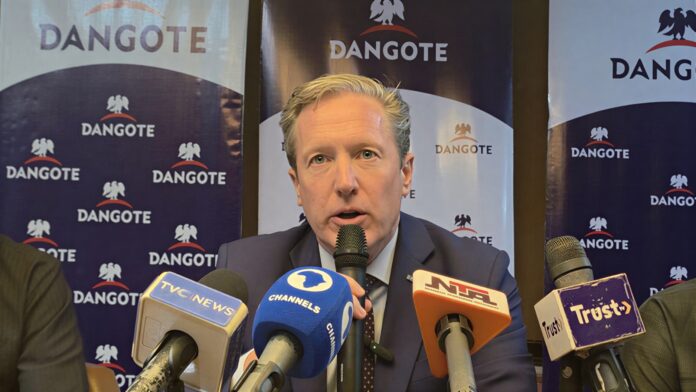
Nigeria’s Dangote refinery says it will prioritise the domestic market to prevent fuel shortages as global oil prices spike following the war in the Middle East.
The pledge comes as crude prices climbed above $100 a barrel this week after US and Israeli strikes on Iran, and Tehran’s subsequent retaliation. The surge has rattled global markets and pushed up fuel costs in import-dependent countries.
Fuel prices in Nigeria have already jumped by about 20 per cent in the past week.
The Dangote refinery prioritises domestic market supply despite mounting international pressure on prices, its managing director, David Bird, told reporters in Lagos on Monday. “Nigeria will continue to enjoy supply security,” Bird said. However, he made clear that the refinery’s commitment depends on access to Nigerian crude.
“Provided we continue to get access to Nigerian crude with the support of the Nigerian government and NNPC, albeit at internationally benchmarked prices, we will continue to process that oil and serve the domestic market with priority,” he said.
The Nigerian National Petroleum Company (NNPC), which is fully government-owned, plays a central role in crude allocation.
The conflict in the Middle East has disrupted global energy markets. Benchmark crude prices moved above $100 per barrel, while shipping and insurance costs also increased sharply.
Bird acknowledged that the refinery cannot fully shield consumers from international price swings. “We are fully exposed to the international commodity market,” he said.
He warned that further price hikes remain possible if crude prices and transport costs continue rising.
Petrol in Lagos now sells at around 1,050 naira per litre, up from 830 naira just days earlier. At the beginning of 2023, the pump price stood at 195 naira per litre.
Before the Dangote refinery began operations in 2024, Nigeria imported nearly all its refined fuel. Shortages occurred frequently despite the country being Africa’s leading oil producer.
The refinery, owned by billionaire industrialist Aliko Dangote, has a processing capacity of 650,000 barrels per day. It now supplies most of Nigeria’s domestic fuel demand.
Its launch marked a turning point for the country’s energy security. However, price stability remains vulnerable to global market volatility.
Bird stressed that stabilising energy prices ultimately falls to policymakers.
“That is the role of government if they want to intervene in the economy when it comes to the cost of energy,” he said.
President Bola Tinubu removed long-standing fuel subsidies shortly after taking office in 2023. Those subsidies had kept pump prices artificially low for years but placed a heavy strain on public finances.
The subsidy removal triggered sharp price increases and sparked protests across parts of the country. The current surge adds fresh pressure on households already facing high living costs.
The Dangote refinery prioritises domestic market supply at a time when Nigeria faces one of its biggest external shocks in years.
While the facility reduces reliance on imports, it cannot fully detach from global oil price movements. As tensions persist in the Middle East, Nigeria’s fuel market will remain closely tied to international developments.