


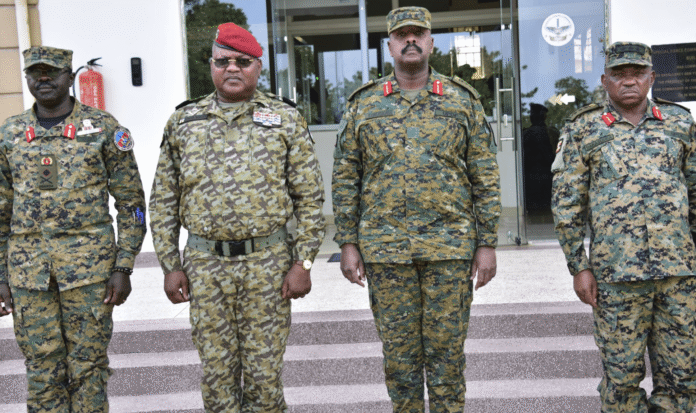
KABALE, Uganda – Uganda’s military leadership has pledged loyalty to President Yoweri Kaguta Museveni following what security chiefs described as the country’s most peaceful general elections since 1996. The pledge came as Uganda marked the 45th anniversary of Tarehe Sita, the launch of the 1981 liberation struggle, a description disputed by some election observers.
Speaking during the celebrations in Kabale, Chief of Defence Forces Muhoozi Kainerugaba congratulated Ugandans for peacefully participating in the 2026 presidential, parliamentary and local council polls.
“Save for a few isolated cases, security was observed in most parts of the country throughout the electoral process,” he said. According to Muhoozi, voters cast their ballots in a “serene, calm and secure environment.”
Military Reaffirms Loyalty to Museveni
Gen. Muhoozi said the Uganda People’s Defence Force and the wider security system pledged “unwavering loyalty” to Museveni as he begins a new mandate from 2026 to 2031.
He added that the President’s leadership and security record had earned confidence beyond Uganda’s borders. “The people of the wider Great Lakes region also celebrated this victory,” he said.
The army chief noted that the country remained calm from north to south and east to west, despite attempts by what he described as “hostile actors” to stir unrest after polling day. He cited incidents in Kampala, Mukono, Jinja, Luweero and Butambala.
Security forces, he said, acted swiftly by arresting and charging suspects. He also praised officers for maintaining stability during both the elections and the festive season.
Major General Sam Kiwanuka, in charge of Production, reflected on more than four decades of service in the army. He joined the force on 4 November 1981.
“Tarehe Sita is not just a day to celebrate, but to acknowledge what we have done,” he said. He recalled the moment Museveni led 27 fighters in an attack on Kabamba Barracks, which marked the start of the armed struggle.
Kiwanuka, a native of Wakiso District, said the UPDF had evolved into a professional and educated force anchored in public support. “This is the people’s army. What we need is the support of the population,” he said.
He also highlighted the military’s investment in agriculture. According to Kiwanuka, the army produces its own food to guarantee security and reduce pressure on the national budget. “Wherever you go in the world, it is a shame for a security institution not to have its own food,” he added.
DON’T MISS THIS: Uganda Opposition Terrorism Charges Expanded as Court Adds 24 Accused
Former Inspector General of Police Kale Kayihura described the changes witnessed over the past 45 years as unmistakable.
“Transformation is a process, not an event,” he said. Kayihura noted that the gains came at a high cost, honouring comrades who died during the struggle.
He urged young people to recognise that today’s stability was built on sacrifice. “What we have gained as a country was built on the bloodshed of their fathers and grandfathers,” he said.
President Museveni used the occasion to link security to economic transformation. He praised the UPDF and other agencies for ensuring election security.
“They did a good job,” he said. Museveni added that groups planning violence “cannot disturb Uganda because our security system is very robust.”
The President outlined plans to accelerate development in the Kigezi sub-region. These include tourism, commercial agriculture and infrastructure projects.
He cited upgrades to tourism roads, the expansion of Kisoro airstrip, and plans for a new international airport to improve access to Bwindi and Mgahinga national parks.
On agriculture, Museveni urged farmers to adopt irrigation and fertilisers. He pointed to model banana plantations in Bushenyi that yield more than 50 tonnes per hectare annually.
Uganda’s leaders framed Tarehe Sita as a moment of remembrance and renewal. They described it as a reaffirmation of security, loyalty and national stability.
Regional military delegations from Rwanda, Kenya, Tanzania, the Democratic Republic of Congo and the Central African Republic attended the ceremony.