


Sudan is facing one of the world’s most severe humanitarian crises, yet it remains largely overshadowed by other global conflicts. Nearly three years after fighting erupted, millions of Sudanese civilians are trapped in a war they did not choose, driven from their homes by violence, hunger and fear.
At its core, the conflict is a power struggle between the country’s two main armed forces, the regular army, known as the Sudanese Armed Forces, and the paramilitary Rapid Support Forces (RSF). What began as a contest for control of the state has turned into a nationwide catastrophe, with civilians paying the highest price.
By December 2025, the war had entered a new and dangerous phase. Fighting shifted away from Darfur towards the central region of Kordofan, an area critical to Sudan’s unity and economic survival. Control of Kordofan determines access to major supply routes, oil infrastructure and the link between eastern and western Sudan. Aid agencies warn that if the region falls entirely into militia hands, the country could effectively split in two.
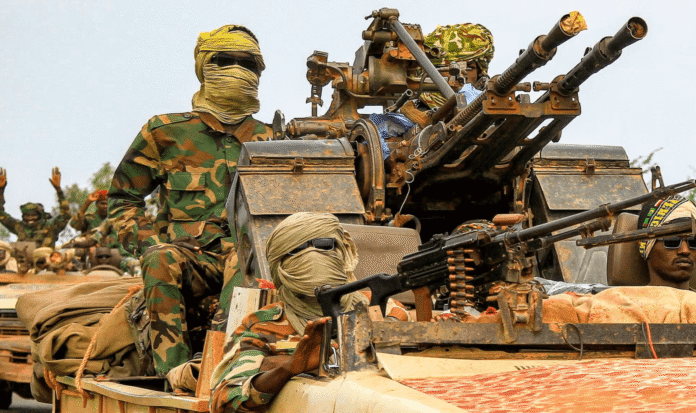
The city of El-Obeid has become one of the conflict’s most important flashpoints. Once a commercial hub surrounded by farmland, it now sits on the frontline. Convoys of soldiers race through its outskirts while families flee in the opposite direction, packed into trucks and minibuses with whatever belongings they can carry. Many head east towards Kosti, hoping to reach areas still held by the army.
The humanitarian situation has deteriorated sharply. The United Nations has warned that aid operations are being forced into “survival mode” because of severe funding shortfalls. Without urgent support, millions face the risk of starvation in 2026. Food systems have collapsed in large parts of the country, health services are barely functioning, and access to clean water is increasingly limited.
Displacement has become a defining feature of the war. Entire communities have been uprooted multiple times, first by clashes, then by hunger. Homes are abandoned not only because of fighting, but because survival has become impossible. In some areas, civilians have been deliberately targeted or intimidated to clear territory, a tactic that has accelerated ethnic violence and deepened mistrust.
So whose war is this? It is not the war of farmers, teachers or children. It is a struggle for military dominance between armed elites, fought in cities and villages where ordinary people have no protection. Civilians are not choosing sides; they are trying to stay alive.
The international response has been uneven. While neighbouring countries have taken in refugees, global diplomatic pressure has failed to produce a lasting ceasefire. Peace talks have stalled repeatedly, and enforcement mechanisms remain weak. Aid organisations continue to call for safe corridors, sustained funding and accountability for abuses, but access remains limited and dangerous.
Sudan’s crisis is not just a humanitarian emergency; it is a test of global resolve. Without stronger international engagement, the war risks becoming a permanent condition, with an entire generation growing up displaced, traumatised and forgotten.
For Sudan’s civilians, the question is no longer who will win the war, but whether the world will act before the cost becomes even higher.