


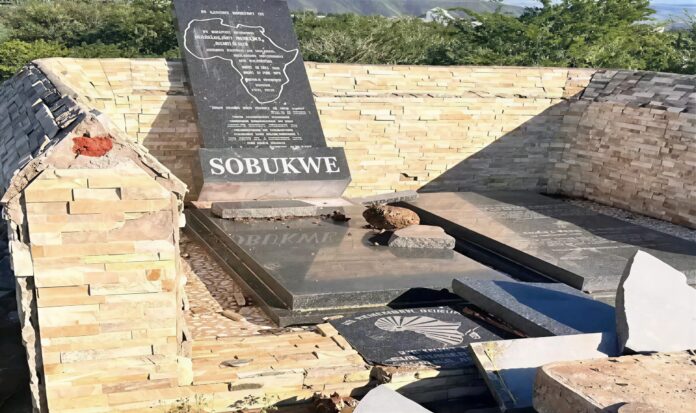
The grave of PAC founding president Robert Mangaliso Sobukwe has been vandalised in Graaff-Reinet, recently renamed in his honour. The Robert Sobukwe grave vandalisation incident has sparked outrage, with many describing it as a direct attack on African history and dignity.
Authorities discovered the vandalism on Wednesday morning at Sobukwe’s gravesite in Asherville, Graaff-Reinet. The timing has intensified public reaction. The incident occurred just days after community members marched in support of renaming the town to Robert Sobukwe Town.
Renaming Controversy Deepens Political Divisions
On 6 February 2026, Graaff-Reinet was officially renamed Robert Sobukwe Town. The decision forms part of a broader wave of renamings across South Africa. East London became KuGompo City, while Aberdeen was renamed Xamdeboo.
These changes have generated political debate. The Freedom Front Plus and the Democratic Alliance have called for reversals. The renaming process continues to reflect deep tensions around identity, heritage, and Sobukwe’s legacy.
Observers have highlighted the proximity between the renaming march and the incident of grave vandalism at Robert Sobukwe’s grave. Sobukwe’s grandson, Mangaliso, acknowledged suspicions that the vandalism was linked to recent events. However, he noted that the desecration of his grandfather’s grave is not new. Similar incidents have occurred over the years.
The Pan-Africanist Congress (PAC) condemned the act. The organisation described the vandalism as an attack on African dignity, history, and resistance. It called on law enforcement agencies to investigate and respond decisively.
The PAC also confirmed that Sobukwe’s gravesite has faced vandalism before. Records show incidents dating back to 2001, reflecting the enduring controversy surrounding his legacy.
Robert Mangaliso Sobukwe founded the Pan-Africanist Congress and played a pivotal role in the anti-apartheid struggle. He led the 1960 anti-pass law protests that culminated in the Sharpeville Massacre. That event marked a turning point in South African and global history.
After his arrest, the apartheid government introduced a special law to keep him imprisoned indefinitely. Authorities referred to it as the “Sobukwe Clause.” Following his release from Robben Island, the state placed him under house arrest until his death in 1978. His legacy remains central to debates about African nationalism, liberation history, and South Africa’s identity.
The Department of Sport, Arts and Culture has confirmed it will collaborate with relevant stakeholders. Officials plan to assess the damage and restore the gravesite.
However, beyond repairing the physical damage, the Robert Sobukwe grave vandalised incident raises deeper questions. What does it say about a nation when it fails to protect the resting place of one of its liberation leaders?