


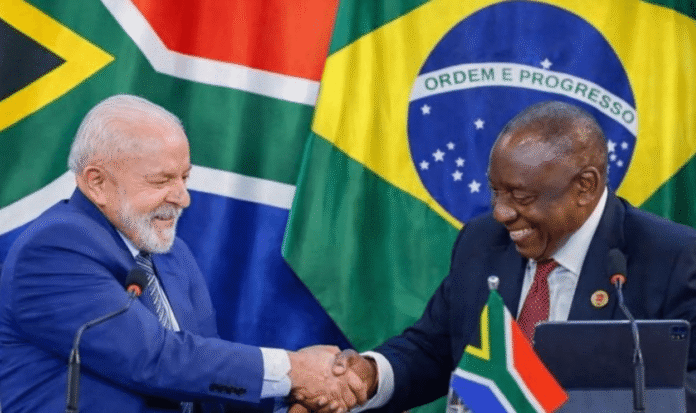
Brasilia —South Africa’s President Cyril Ramaphosa’s State Visit to Brazil this week comes at a time when global alliances are shifting and emerging economies are seeking a stronger collective voice.
Invited by President Luiz Inácio Lula da Silva, Ramaphosa is in Brasília for a two-day visit focused on deepening ties between two of the most influential members of the Global South. While state visits often carry ceremonial weight, this one has been shaped by pressing geopolitical and economic realities.
South Africa and Brazil formalised their strategic partnership in 2010. Sixteen years later, both governments appear determined to give that relationship sharper economic and political substance.
Ramaphosa and Lula held high-level talks at the Palácio do Planalto on Monday, covering bilateral cooperation as well as coordination within multilateral platforms such as BRICS, the G20, IBSA and the United Nations.
Both countries see themselves as advocates for reform in global governance structures. South Africa has consistently argued for fairer representation of developing nations in financial institutions and decision-making bodies.
In Brasília, that shared vision appeared central to discussions. As geopolitical tensions intensify elsewhere, from trade disputes to armed conflicts, Pretoria and Brasília are positioning themselves as partners in shaping a more multipolar world.
For South Africa, alignment with Brazil strengthens its standing within BRICS and reinforces its role as a continental voice in global negotiations.
Economic cooperation featured prominently during the visit. Bilateral trade between the two countries reached R32.5 billion in 2025, but both sides believe it can grow significantly.
Talks focused on expanding collaboration in agribusiness, aerospace, mining, energy and science and technology. These sectors reflect practical national priorities.
Brazil brings global expertise in agriculture and biofuels. South Africa is navigating an energy transition while seeking industrial expansion and infrastructure development. Officials say partnerships in these areas could create opportunities for technology transfer and investment.
Ramaphosa addressed the South Africa–Brazil Business Forum at the Itamaraty Palace, encouraging business leaders to turn political goodwill into concrete commercial projects.
For Pretoria, diversifying trade relationships remains essential. As global markets become more unpredictable, broader partnerships reduce vulnerability.
Mobility and tourism also formed part of the discussions. Officials are considering a new bilateral air-services agreement that could double weekly flight frequencies between the two countries.
If implemented, flights could increase from 14 to 28 per week. This would make travel easier for business, tourism and academic exchange.
South Africa recently added Brazil to its 90-day visa-exemption list, a move aimed at encouraging tourism and investment. Increased connectivity between Latin America and Africa could open new economic corridors that bypass traditional European routes.
Ramaphosa did not travel alone. His delegation includes International Relations Minister Ronald Lamola, Defence Minister Angie Motshekga, Electricity and Energy Minister Kgosientsho Ramokgopa, Tourism Minister Patricia De Lille and Trade, Industry and Competition Minister Parks Tau.
Their presence signals that this visit extends beyond diplomatic symbolism. Energy cooperation, defence dialogue, trade facilitation and tourism expansion all form part of the broader agenda.
Officials say such coordination ensures that agreements reached at leadership level translate into practical outcomes. The visit underscores South Africa’s effort to balance relationships across a fragmented global landscape. While maintaining ties with Western partners, Pretoria is also deepening cooperation with fellow emerging economies.
Brazil, as Latin America’s largest economy, offers South Africa both political alignment and economic opportunity. In an increasingly divided international environment, South Africa appears intent on building bridges within the Global South while asserting its own strategic autonomy.
Whether the outcomes translate into sustained economic growth will depend on follow-through in the months ahead. But in Brasília this week, the message from Pretoria was clear: South Africa intends to remain active and influential in shaping the future of global cooperation. And in a world marked by uncertainty, that diplomatic posture carries its own significance.