


By Tendai Nheta
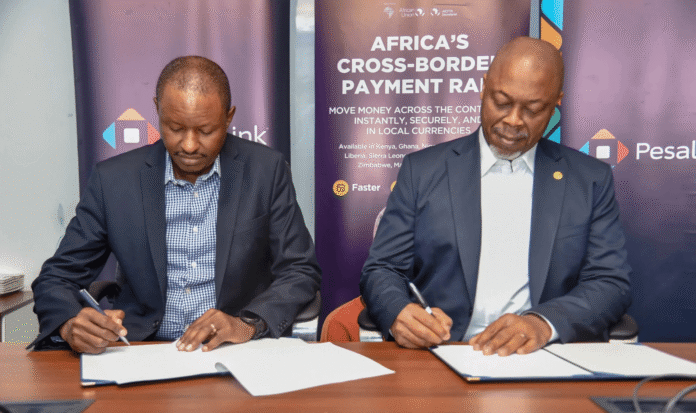
Nairoi, 27 February 2026 – Kenya’s instant payment network, Pesalink, has struck a new partnership with the Pan-African Payment and Settlement System (PAPSS), in a move aimed at reshaping how money moves across African borders.
The agreement links Kenya’s domestic real-time payment infrastructure directly to a continent-wide settlement platform backed by the African Export-Import Bank (Afreximbank). For businesses and individuals, the promise is straightforward: faster cross-border payments, lower costs and transactions settled in local currencies rather than routed through foreign banking hubs.
Sending money across African borders remains surprisingly complex. Despite advances in mobile banking and fintech, many transactions still rely on correspondent banks outside the continent. Payments are often cleared in US dollars or euros before being converted back into local currencies.
That structure adds time and cost. According to the World Bank’s 2023 Remittance Prices report, transferring money within Africa costs on average between 7% and 8% of the amount sent, higher than the global average. Settlement can take several days.
For small and medium-sized enterprises (SMEs), traders and diaspora families, those delays and fees carry real consequences.
The Pesalink–PAPSS partnership aims to change that equation. Under the arrangement, cross-border payments initiated by PAPSS participants across Africa will now settle directly into Kenyan banks and mobile money operators connected to the Pesalink network. Transactions will run 24 hours a day, seven days a week, and will be completed in local currencies.
In practical terms, that means fewer intermediaries, less reliance on foreign reserve currencies and a simpler settlement process.
Linking Kenya to the continental grid
Pesalink operates as Kenya’s interoperable real-time payment system. Through its infrastructure, customers can transfer funds instantly between bank accounts, mobile money wallets, fintech platforms and savings cooperatives.
Now, as a Technical Connectivity Provider to PAPSS, Pesalink connects more than 80 Kenyan institutions, including banks, SACCOs, fintech firms and telecom operators, to over 160 commercial banks and financial institutions already active on the PAPSS platform across Africa.
PAPSS itself was created by Afreximbank in partnership with the African Union and the African Continental Free Trade Area (AfCFTA) Secretariat. The system forms part of a broader effort to remove financial friction as African countries seek deeper trade integration under AfCFTA.
For PAPSS Chief Executive Mike Ogbalu III, collaboration at the national level is essential to achieving scale.
“For PAPSS to deliver true impact, collaboration with national and private switches like Pesalink is essential,” he said at the signing ceremony in Nairobi. “Pesalink is the first switch we’ve piloted for transaction termination in Kenya, and we are already seeing greater adoption by opening more channels for seamless, local-currency cross-border payments across Africa.”Kenya plays a pivotal role in East Africa’s digital economy. The country has built one of the continent’s most advanced mobile money ecosystems, and its banking sector increasingly supports regional trade flows.
Pesalink’s Chief Executive, Gituku Kirika, said the partnership strengthens that position.
“Kenyan banks will now be able to offer faster, cheaper cross-border payments,” he said. “They will be helping their customers grow more regional trading relationships and thrive in a more integrated digital economy.”
The timing matters. As AfCFTA gathers momentum, policymakers and financial institutions face growing pressure to modernise payment infrastructure. Tariff reductions and trade agreements carry limited weight if payments remain slow or prohibitively expensive.
By settling transactions in local currencies, PAPSS reduces foreign exchange pressures and cuts out the need to route payments through offshore clearing banks. That not only lowers transaction costs but also keeps liquidity within African financial systems.
Building financial integration from within
The partnership reflects a wider shift in how African financial institutions approach integration.
For decades, African cross-border payments often depended on financial centres outside the continent. Now, regional platforms such as PAPSS aim to internalise those flows, creating an African clearing and settlement architecture designed for African trade.
Pesalink’s integration signals that domestic instant payment systems can plug directly into continental networks without losing their local functionality.
Integrated Payment Services Limited (IPSL), which operates Pesalink under the Kenya Bankers Association, was established in 2015 under Kenya’s National Payment System Act. Since then, it has become a central pillar of the country’s real-time payments ecosystem.
PAPSS, meanwhile, has expanded steadily since its launch, bringing together central banks and commercial institutions across multiple African regions.
Together, the two platforms illustrate how financial integration increasingly rests not only on policy frameworks but also on technical interoperability.
For individual users, the changes may feel incremental at first. A trader sending funds from Nairobi to Accra, or a supplier receiving payment from Lagos, may simply notice that the money arrives faster and at lower cost.
For SMEs, however, predictability and speed are critical. Working capital constraints often limit the ability to expand across borders. Faster settlement cycles reduce uncertainty and free up cash flow.
Large corporates stand to benefit as well, particularly those operating in multiple African markets and seeking streamlined treasury operations.
The success of the partnership will ultimately depend on adoption by banks, fintech platforms, and customers. But by aligning a national instant payment network with a continental settlement system, Pesalink and PAPSS are attempting to address one of Africa’s most persistent trade bottlenecks.
If the model scales effectively, it could mark a turning point in how African economies move money — not through distant intermediaries, but directly between themselves.