


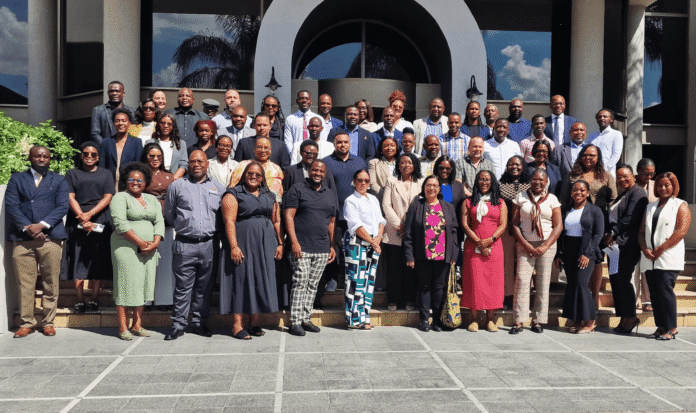
Namibia is taking practical steps to turn the African Continental Free Trade Area (AfCFTA) from policy into action. While many African countries have ratified the agreement, implementation remains uneven. Trade within the continent is still below potential, largely due to infrastructure gaps, policy misalignment and limited awareness among businesses.
By validating its Step-by-Step Guide for Trading in Goods under the AfCFTA, Namibia is positioning itself to close that gap. The move signals a shift from commitment to execution, providing businesses with a clear framework for accessing continental markets. Fence Africa 24 spoke to Namibia’s Ministry of International Relations and Trade to understand what this means for the private sector and regional integration.
Ms Ndiitah Ngbipondoka – Robiati, Executive Director & Permanent Secretary at Ministry of International Relations & Trade, responded to questions from Fence Africa 24 Correspondent, Kholekile Mnisi.
How will Namibia’s validation of the Step-by-Step Guide for trading in goods under the AfCFTA boost private sector participation in continental trade, and what is the expected impact on intra-African trade?
The validation of the Step-by-Step Guide is a significant milestone for Namibia’s implementation of the AfCFTA. The Guide explains the practical processes required to trade in goods under the Agreement, particularly for the private sector. By clearly outlining procedures such as rules of origin, customs documentation, tariffs, and regulatory requirements, the Guide reduces uncertainty and compliance costs for businesses.
For Namibian enterprises especially SMEs this clarity is expected to encourage greater participation in continental trade by lowering entry barriers. Over time, increased utilization of AfCFTA preferences by the private sector is expected to contribute to higher volumes of intra-African trade, improved market diversification, and stronger regional value chain participation by Namibian producers.
What specific gaps in trade information and processes does the Step-by-Step Guide address, and how will it enhance transparency and ease of access for business?
The Guide addresses key information gaps that businesses often face, including fragmented trade information, limited understanding of AfCFTA-specific procedures, and inconsistent access to up-to-date regulatory requirements. It consolidates essential trade-related information into a single, user-friendly reference that explains what to do, where to go, and who to engage at each stage when trading across borders.
By standardising and simplifying information, the Guide enhances transparency, improves predictability, and supports informed decision-making by traders. This is particularly important for first-time exporters and smaller firms that may lack the capacity to navigate complex trade systems.
How will the Namibia Trade Information Portal be linked with other platforms like STIP and Aetrade Sokokuu to promote efficiency?
The Namibia Trade Information Portal is intended to function as a national gateway to trade-related information. Where feasible and appropriate, it will be interoperable with regional and continental platforms such as the SADC Trade Information Portal (STIP) and AfCFTA-supported platforms like Aetrade Sokokuu.
This linkage will promote efficiency by reducing duplication of information, enhancing consistency across platforms, and allowing traders to access relevant national, regional, and continental trade requirements from connected systems. Importantly, Namibia’s portal will continue to reflect national laws and procedures, while complementing broader regional and continental initiatives.
SADC Commitments and Regional Integration
How does Namibia’s validation of the Guide align with SADC’s regional integration goals, and what implications does this have for SADC member states?
Namibia’s validation of the Guide aligns with SADC’s broader objectives of trade facilitation, market integration, and industrial development. While Namibia cannot speak on behalf of all SADC member states, this national initiative demonstrates how AfCFTA implementation can complement existing regional integration efforts.
The Guide may serve as a reference point or best practice for other interested SADC countries as they develop or refine their own AfCFTA implementation tools, while respecting national contexts and obligations.
What role can SADC play in harmonizing trade procedures and regulations to facilitate smoother implementation of AfCFTA across member states?
SADC can play a facilitative and coordinating role by promoting dialogue, information-sharing, and gradual alignment of trade procedures where possible. Through its existing structures, SADC can support the identification of common challenges, encourage mutual recognition of procedures to address non-tariff barriers, and assist member states in aligning regional instruments with AfCFTA commitments.
However, implementation remains a sovereign responsibility of individual member states under the AfCFTA framework.
How will SADC countries leverage AfCFTA to increase intra-regional trade and industrialization?
AfCFTA presents an opportunity for SADC countries to expand markets beyond the region while strengthening intra-regional value chains. By leveraging comparative advantages, improving trade facilitation, and promoting industrial linkages, SADC countries can use AfCFTA as a platform to boost manufacturing, agro-processing, and regional supply chains.
Each country will determine its own strategies based on national development priorities.
Challenges and Gaps
What are the key challenges Namibia and other SADC countries face in implementing AfCFTA, and how can these be addressed?
Key challenges include limited awareness among businesses, infrastructure constraints, capacity gaps in implementation institutions, and the persistence of non-tariff barriers. Addressing these challenges requires sustained capacity building, digitalization of trade processes, enhanced coordination among agencies, and continuous engagement with the private sector.
Are there concerns about non-tariff barriers or regulatory hurdles that could limit market access under AfCFTA, and how are these being tackled?
Yes, non-tariff barriers remain a concern under the AfCFTA. At continental level, the Agreement provides tools such as the Mechanism for the Monitoring, Reporting and Elimination of Non-Tariff Barriers, which enables countries and businesses to identify and address regulatory and procedural challenges. At national level, Namibia is strengthening coordination among regulatory authorities to improve compliance, transparency, and predictability.
In addition, Namibia has introduced the Trade Obstacle Alert Mechanism, a digital platform that allows traders, importers, and exporters to report and track trade barriers in real time. This strengthens public-private dialogue, supports faster resolution of challenges at border posts, and contributes to improving market access, including in trade in services.
How will the AfCFTA’s focus on trade in goods be expanded to include services and other protocols in the future?
The AfCFTA is being implemented in phases. Phase I negotiations, which cover Trade in Goods, Trade in Services, and the Protocol on Rules and Procedures on the Settlement of Disputes, have been concluded. While the Protocol on Trade in Goods is the most advanced in terms of implementation, work on the finalisation and operationalisation of specific commitments under the Protocol on Trade in Services is ongoing. Phase II negotiations, which cover the Protocols on Investment, Intellectual Property Rights, Competition Policy, and Digital Trade, are currently underway. These protocols will be progressively operationalised as the necessary legal, regulatory, and institutional frameworks are finalised at national, regional, and continental levels.
Private Sector Engagement and Impact
How is the private sector in Namibia and SADC countries being engaged in the implementation of AfCFTA, and what benefits do they expect?
In Namibia, the private sector is engaged through consultations, validation workshops, awareness campaigns, and capacity-building initiatives. Businesses expect improved market access, reduced trade costs, and opportunities to integrate into regional and continental value chains.
Engagement approaches in other SADC countries vary according to national arrangements.
What capacity-building initiatives are planned to support businesses in leveraging AfCFTA opportunities?
Alongside implementation, Namibia has placed strong emphasis on business engagement and awareness. Last year, the Honorable Minister undertook nationwide engagements with the business community across all 14 regions to raise awareness on the AfCFTA and its opportunities. Similar outreach initiatives are expected to continue this year.
In addition, platforms such as a Youth Forum on the AfCFTA are in the pipeline to ensure broader and more inclusive participation. Planned support measures include targeted training on AfCFTA rules and procedures, the dissemination of simplified guides, the use of digital trade tools, and strengthened trade information systems, with particular focus on SMEs, women-led businesses, and youth entrepreneurs.
How will the Step-by-Step Guide and Trade Information Portal promote inclusive trade and support SMEs in accessing the continental market?
The Guide and Portal are designed to be practical, accessible, and user-friendly. By simplifying complex procedures and centralizing information, they reduce the cost of compliance and information asymmetry that disproportionately affect SMEs. This supports more inclusive participation in continental trade.
Looking Ahead
What are the next steps for Namibia and SADC countries in implementing AfCFTA, and how will progress be monitored?
For Namibia, next steps include finalizing and disseminating the Guide, operationalizing digital trade tools, and strengthening monitoring mechanisms. Progress will be tracked through utilisation of AfCFTA preferences, private sector feedback, and institutional reporting structures.
Other SADC countries will advance implementation in line with their national frameworks.
How do AfCFTA goals fit into broader African economic integration and development objectives?
AfCFTA supports Africa’s long-term goals of economic integration, industrialization, job creation, and sustainable development. It complements Agenda 2063 by promoting a more integrated, resilient, and competitive African economy.
What are the potential risks and opportunities for SADC countries in AfCFTA implementation?
Opportunities include expanded markets, industrial growth, and stronger value chains. Risks include uneven readiness levels, adjustment pressures on local industries, and capacity constraints. Managing these risks requires phased implementation, targeted support measures, and continued regional cooperation.