


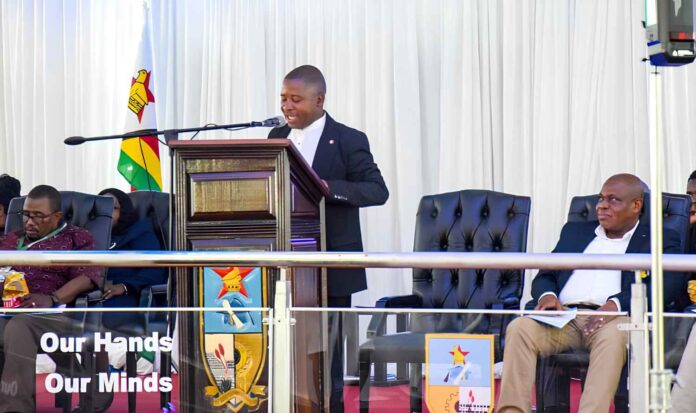
Students today are trained to be employees, not employers. Dr Prosper Mutswiri, President of the Midlands State University (MSU) Global Alumni Interim Steering Committee in Zimbabwe, wants to change that. He has challenged graduates to embrace excellence and drive a productive, progressive Africa.
Speaking at a recent MSU Alumni Reunion and Business Expo in Gweru, Zimbabwe, Dr Mutswiri said graduates must be excellent and productive.
“Be excellent in what you do. Be productive in how you work. Be united in why you act. Because your education was never meant to produce comfort alone; it was meant to produce competence, character, and momentum for a continent that needs industrious hands and clear purpose,” he said.
Mutswiri spoke as a son of the institution, shaped by its demands and discipline. He called on alumni to carry their purpose into the future with seriousness. Returning to a former university is not enough. Alumni must come back to build, not just to remember.
“We have come to define a new duty. We have a duty to contribute to the development of our communities, our nation and indeed the entire continent and beyond.
Our alumni pride should not remain emotional. It must become organised value; turning affection into structure, belonging into strategy, and alumni identity into national and regional contribution,” he said.
On purpose and responsibility, Dr Mutswiri urged alumni to treat the reunion as a declaration that university education matters to Zimbabwe, the region, and Africa. Sentiment alone, he insisted, will not secure the future of tertiary learning. That future demands intelligence, deliberate investment, courageous leadership, and loyal action.
“Let us connect to the development reality surrounding us by linking excellence and productivity to national industrialisation, job creation, youth development, and the skills transformation demanded across Africa,” he said.
Mutswiri argued that alumni must align with the national direction. Zimbabwe’s development priorities run from January 2026 to December 2030. The drive includes building competitive, modernised systems through science, technology, innovation, and Higher Education 5.0.
“Let us align our efforts with the national direction bearing in mind Zimbabwe’s national development priorities running from January 2026 to December 2030, including infrastructural development, technology innovation and human capital development, job creation, and youth development,” he said.
Beyond national contribution, Dr Mutsiwiri also moved the development agenda beyond borders, into Pan-African responsibility.
Referencing Agenda 2063, he described Africa’s future as prosperous and integrated. African citizens must drive it. Skills revolutions, industrialisation, beneficiation, and value addition are the anchors.
“Universities must not produce graduates who chase private survival as isolated individuals. They must produce connected Africans. People who build institutions, solve problems, retain talent on the continent, and link local excellence to continental resurgence.
Our focus must shift to deals we can implement in systems. A diaspora cannot be useful to a university that cannot see itself. Full organisation is essential. This means a complete alumni register, a living database of skills, sectors, locations, and willingness to serve. It means functioning locally and internationally. It also means an alumni portal that activates people, not just stores names. Coordination becomes far easier when the foundation is in place,” he said.
Mutswiri also called for an encyclopedia of ideas. This structured repository would draw on alumni experience. It would guide curriculum relevance, financing models, digital transformation, and research opportunities. Governance, student welfare, entrepreneurship, industrial partnerships, public policy, and internationalisation would also benefit.
“As graduates, we must become the bridge between the university and the corporate world. Graduates must become employable talent. Alumni influence must open pathways for industrial attachment, internships, job placement, mentorship, and real-world innovation,” he said.
Mutswiri also focused on mentorship and entrepreneurship as acts of loyalty. Seasoned graduates must stand beside younger ones. Confidence and direction must become real, transferable skills.
“Producing graduates who only seek jobs is not enough. Alumni must help produce graduates who create jobs. Student enterprises, alumni-owned businesses, market access, business showcases, and practical incubation are the tools. The Alumni Business Expo must become a sustained pipeline, not a one-time event.
Our excellence must live in conduct, competence, credibility, and voice. The first brand strategy is not publicity; it is alumni character. Evidence comes second. Visibility comes third.
So excellence becomes lived behaviour: building instead of cutting corners, proving capability, and speaking on behalf of MSU through results,” he said.
Mutswiri also spoke about wisdom in the age of Artificial Intelligence (AI) and the ability to connect experience to new tools. He said, “In a world reshaped by artificial intelligence and global competition, we must reject extremes. Wisdom has not expired. It must simply be connected to new tools. Let us respond ethically and intelligently to the future, ensuring that innovation strengthens national development and African progress”
When the future asks what alumni did at a decisive moment, the answer must be unmistakable. We must be remembered not only as those who returned, organised, built, and gave, but as those who transformed the university and nation, creating a bridge to Africa’s progress and inspiring a legacy of action, impact, and unity.