
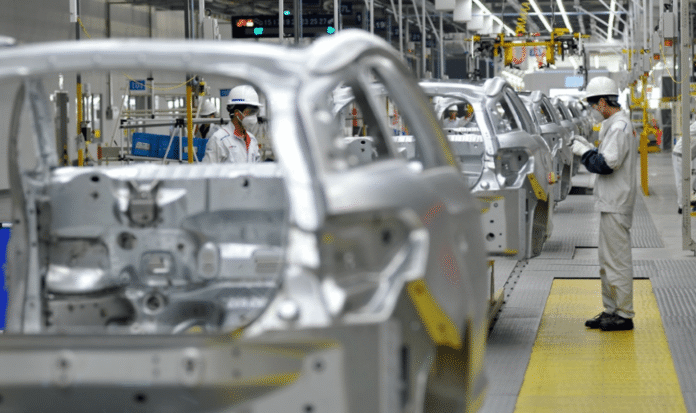
French automakers Nigeria partnership is reshaping the country’s auto industry. Peugeot has teamed up with Dangote Group to relaunch vehicle assembly through Dangote Peugeot Automobiles Nigeria. Renault has partnered with Coscharis Group to strengthen its market presence. Together, the collaborations aim to produce 44,000 vehicles annually.
Two major collaborations drive this revival, targeting annual production and sales of 44,000 vehicles in Nigeria. Peugeot (under Stellantis) has partnered with Dangote Group through DPAN, while Renault has joined with Lagos-based Coscharis Group to assemble and market vehicles locally.
The partnerships were highlighted by Marc Fonbaustier, the French Ambassador to Nigeria, who described the joint efforts as an “ambitious but achievable” path toward re-establishing French automakers’ presence in one of Africa’s most promising markets.
French brands were once household names on Nigerian roads. From the early 1970s, Peugeot Automobile Nigeria (PAN) operated a major assembly plant in Kaduna State, producing models like the Peugeot 404 and Peugeot 504, vehicles that became fixtures on government fleets, company car parks and private garages alike.
However, economic instability, changes in industrial policy, and an influx of cheaper imported vehicles reduced local assembly capacity in the late 20th and early 21st centuries. Higher production costs and foreign exchange constraints made it difficult for domestic plants to compete with lower-priced imported second-hand cars, known locally as “Tokunbo.”
Now, nearly half a century after PAN’s heyday, France’s auto sector is recalibrating. The aim is not simply to sell cars, but to build a manufacturing ecosystem that combines foreign tech. Nearly fifty years after PAN’s peak, France’s auto sector is shifting its approach.
The goal extends beyond selling cars to building a manufacturing ecosystem that integrates foreign technology with Nigerian industrial ambition. The expansion plans encompass the 308 hatchback, the stylish 3008 and 5008 SUVs, and the upscale 508. Production will focus on vehicles suited to Nigerian road conditions and consumer preferences.
DPAN’s relaunch signifies more than restarting assembly operations. It is a strategic partnership between Nigeria’s leading industrial conglomerate and a global automotive group. For Dangote, auto manufacturing presents new opportunities for value addition and job creation. For Stellantis and Peugeot, it offers access to a market experiencing rapid urban growth and an expanding middle class.
The second initiative involves Renault partnering with Coscharis Group, a leading Nigerian auto distributor and assembler. Renault vehicles, especially Logan variants, will be co-produced for the Nigerian and West African markets. This collaboration leverages Renault’s global presence and Coscharis’s extensive distribution network.
With global auto production facing supply chain disruptions and regional markets seeking resilience, localised assembly, importing components, and building vehicles domestically have become increasingly important. Nigeria’s partnerships reflect this trend, combining foreign technology with local production for shared benefit.
The revival of French auto partnerships in Nigeria addresses broader economic priorities, including job creation, industrial diversification, and skills development. The automotive value chain, from parts suppliers to service networks, can stimulate domestic manufacturing, reduce reliance on imports, and enhance technological expertise.
Challenges persist. The Nigerian economy faces foreign exchange volatility and high production costs, which have historically made local assembly less competitive than imports. Making locally assembled vehicles affordable for consumers will be critical to the success of these initiatives.
Competition from Asian manufacturers is also increasing. Chinese and Indian brands have expanded rapidly in Nigeria, offering affordable models and establishing local assembly operations. Their vehicles attract price-sensitive consumers and are supported by strong financing, marketing, and after-sales service. French automakers must differentiate themselves by emphasizing the quality, safety, and long-term support of locally produced, warranty-backed vehicles.
Despite these challenges, the partnerships demonstrate confidence in Nigeria’s long-term automotive potential. French automakers are pursuing a gradual re-entry based on strategic collaboration, industrial infrastructure, and market insights. As Ambassador Fonbaustier noted, the automotive sector operates in long cycles, and rebuilding France’s presence in Nigeria will require time.
For Nigeria, revitalising the auto sector is more than economic diversification. It is a strategic effort to reclaim a key industry, create sustainable jobs, and demonstrate readiness to revive large-scale manufacturing and strengthen local capacity.
After decades of import dominance, the relaunch of assembly lines in Kaduna and Lagos marks a pivotal shift. Africa’s largest economy is investing in its manufacturing future and leveraging partnerships to drive growth and shared prosperity.