


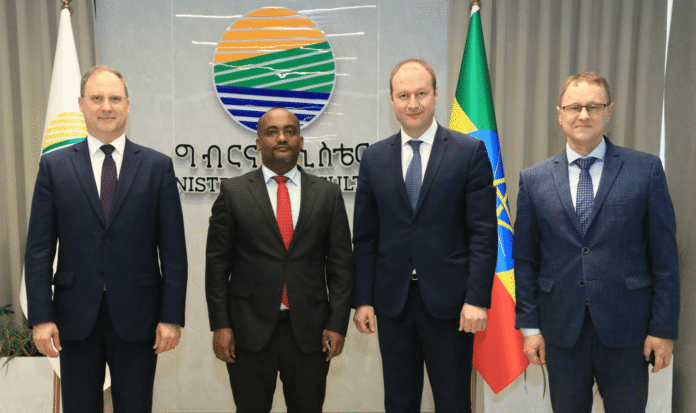
Ethiopia and Russia are stepping up cooperation in agriculture, seeking to strengthen their diplomatic ties and deliver practical economic results.
On 18 March 2026, Ethiopia’s Minister of Agriculture, Addisu Arega Kitessa, met in Addis Ababa with a Russian delegation led by Deputy Minister Maxim Markovich. The talks covered agricultural input supply, mechanisation, and technology transfer.
The two sides agreed to step up cooperation in areas expected to boost productivity and trade. Priorities include improving the supply of agricultural inputs, increasing trade in coffee, oil crops and horticulture, expanding access to agrochemicals and machinery, and supporting knowledge and technology transfer.
Ethiopia and Russia have longstanding diplomatic ties, but recent years have seen a shift toward economic partnership. Bilateral trade nearly tripled in 2025 to over US$435 million, driven mainly by agriculture. Ethiopian coffee exports from regions like Sidamo and Harar have risen sharply in Russia, boosting agricultural trade.
The growth in coffee exports points to wider opportunities for cooperation. Russia’s increased supply of fertilisers, machinery and grain meets Ethiopia’s demand for modern agricultural inputs.
Talks between the agricultural ministries are part of Ethiopia’s push to modernise its farming sector. By focusing on mechanisation and value chains, Ethiopia aims for concrete development, with Russian cooperation seen as important for new technology and wider market access.
Trade diplomats say these talks are part of broader economic discussions. In November 2025, an intergovernmental commission met to expand cooperation into industry and technical sectors, and discussed scientific and technology exchange to support agricultural innovation.
For Ethiopia, the partnership has strategic importance beyond trade numbers. Agriculture supports millions of livelihoods and is central to the economy. Working with Russia boosts export opportunities, diversifies sources for key farming inputs, and reduces reliance on traditional import markets.
Russian officials see Ethiopia as a gateway to East African markets. Increased Ethiopian exports diversify Russia’s trade, while Russian machinery and fertilisers find new demand.
Officials from both countries say the partnership is part of a long-term strategy. As Ethiopia pursues its development and export goals, ongoing cooperation with Russia is seen as key to the country’s economic future.