
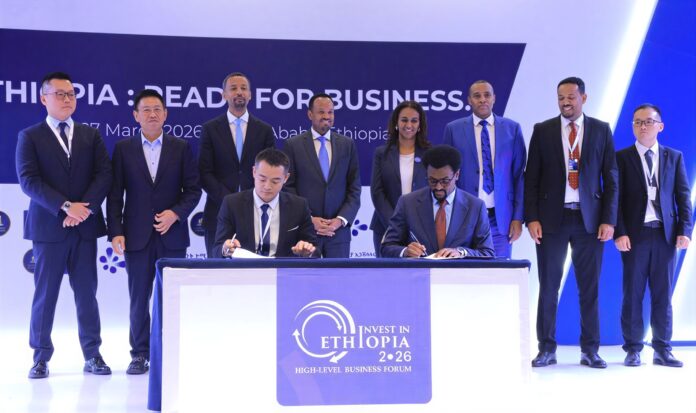
Ethiopia has unveiled more than $13.1 billion in new investment deals at the fourth Invest in Ethiopia 2026 High-Level Business Forum in Addis Ababa. The agreements span energy, manufacturing, mining, real estate and industrial development. Government officials, investors and business leaders attended the forum. Together, they used the event to present Ethiopia as a serious destination for long-term investment.
For the Ethiopian government, the forum was about more than large numbers. It was also a statement of intent. Officials wanted to show that Ethiopia is not just a market with promise. They want it seen as a country ready for major projects and long-term capital.
The biggest proposed investment came from Ming Yang Smart Energy Group Limited. The company announced plans for a project worth more than $10 billion. The investment will focus on renewable energy, hydrogen and green ammonia. If it moves ahead, it could become one of the most significant energy commitments presented at the forum.
Global Future Investment Ltd. made another major pledge. It allocated $2 billion for a Special Economic Zone focused on manufacturing. That commitment reflects Ethiopia’s continued belief in industrialisation, export production and factory-led growth.
Several other companies also featured in the forum’s investment slate. Liaoning Fangda Group Industrial Co., Ltd. said it would invest $500 million in steel and pharmaceutical manufacturing plants. Rashmi Group announced a $235 million commitment for gold, lithium and other mineral exploration. Those projects show that Ethiopia still attracts investors interested in both industry and extraction.
In the renewable energy sector, Gobez Electric Manufacturing Plc said it would invest an additional $150 million to expand solar cell manufacturing. Sun King also outlined a $150 million plan that will run through 2030. The company wants to expand access to off-grid solar systems for households and businesses. Together, these commitments strengthen Ethiopia’s push for energy access and local renewable technology.
Quantum-Everest completed the list of companies introduced at the forum. It allocated $100 million to support investment from Poland into Ethiopia. The company said it wants to invest in real estate development and commercial activity. Although smaller than the largest deals, the commitment still points to Ethiopia’s effort to widen both its partnerships and its investment base.
Taken together, the seven agreements show where Ethiopia is placing its bets. The country is targeting energy, industry, mining, infrastructure and manufacturing. Officials say these sectors will create jobs, improve foreign exchange earnings and support wider economic transformation.
Still, the real test will come later. Investment forums often produce impressive headline figures. What matters more is execution. Ethiopia will now need to show how many of these agreements move beyond the signing stage and into real construction, production and operations.
That is where the country’s credibility will rest. The headlines matter. Delivery matters more. Even so, the forum marks an important moment for Ethiopia. Countries across Africa are competing hard for capital, industrial partnerships and energy-transition finance. Addis Ababa used this forum to make a clear case. Ethiopia wants investors to see it not at the margins of the continent’s economic future, but near the centre of it.