
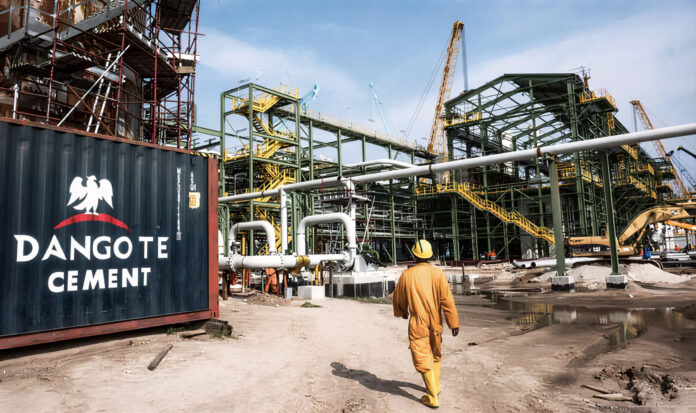
Dangote Cement has achieved its strongest financial performance so far, posting a record profit of $743 million in 2025, more than doubling its earnings from the previous year.
The result marks a pivotal moment for Africa’s largest cement producer and highlights the increasing strength of the continent’s construction and infrastructure sectors. At a time when many emerging economies are facing currency volatility, rising energy costs, and global uncertainty, Dangote Cement has successfully balanced operational discipline with strategic growth.
The outcome is not just a surge in profits but a definitive declaration of intent: the company aims to dominate Africa’s cement industry as its most cost-effective and geographically diversified producer.
The profit increase was supported by a mix of strong pricing, export expansion, and more effective cost management.
Group revenue increased substantially in 2025, driven by improved margins across key markets. While overall cement volumes stayed relatively steady, the company effectively countered volume pressures through disciplined pricing and better operational efficiency.
Earnings before interest, tax, depreciation, and amortisation increased significantly, pushing margins close to 46%. In Nigeria, its most lucrative market, margins neared 60%, reflecting scale benefits and a maturing local operation. Exports also played a vital role. Dangote Cement expanded clinker and cement shipments to neighbouring West African countries, utilising its export terminals in Apapa and Onne to bolster regional trade flows. Export volumes grew substantially, reducing dependence on any single domestic market.
The strategy demonstrates a broader shift in African manufacturing, moving towards developing regional supply chains rather than depending on imports or offshore processing. A significant milestone in 2025 was the commissioning of a new three-million-tonne-per-annum grinding plant in Côte d’Ivoire.
The facility boosts Dangote Cement’s total installed capacity in Africa to approximately 55 million tonnes per year and further expands the company’s presence in francophone West Africa, one of the continent’s fastest-growing construction corridors.
Grinding plants allow companies to import clinker and finish cement closer to end markets, reducing logistics costs and improving pricing flexibility. For Dangote Cement, the Ivory Coast expansion strengthens its ability to respond quickly to rising urban demand and government infrastructure programmes.
The company has stated that additional expansion projects are ongoing in South Africa, Ethiopia, and other African markets, part of a long-term plan that could increase capacity to 80 million tonnes by the end of the decade. Africa’s construction sector continues to benefit from rapid urbanisation, population growth, and infrastructure development.
Governments across the continent are investing heavily in housing, roads, ports, and industrial zones. Meanwhile, private developers are responding to the demand for residential and commercial real estate. Dangote Cement remains at the heart of this ecosystem.
By positioning itself as a low-cost producer with pan-African reach, the company aims to benefit from both public infrastructure spending and private sector expansion.
Its growth strategy also aligns with the African Continental Free Trade Area (AfCFTA), which encourages intra-African trade and regional value chains. Efficient cross-border exports of cement and clinker allow Dangote to leverage tariff reductions and logistical improvements under the new trade framework.
Reflecting confidence in its cash flow and balance sheet strength, Dangote Cement’s board proposed a substantial dividend increase for 2025.
The payout rose by 50%, reinforcing investor confidence and signalling that the company’s earnings growth is translating into tangible shareholder returns.
Such a move suggests management expects operational momentum to continue despite macroeconomic headwinds.
Dangote Cement’s long-term ambition is not merely scale; it is cost leadership. The company has invested in energy efficiency, alternative fuel sources and logistics optimisation. It continues to explore compressed natural gas trucking and other measures to reduce input costs and protect margins.
In a sector where transport and energy represent a large share of total production costs, operational efficiency often determines competitiveness.
By combining integrated plants, regional grinding facilities and export terminals, Dangote has built a network that allows it to serve multiple markets without overexposure to currency fluctuations or localised downturns.
Dangote Cement’s record profit does more than highlight corporate success. It reflects a broader shift in Africa’s industrial capacity.
For decades, cement demand across the continent often depended on imports. Today, African-based producers increasingly supply local and regional markets at scale.
As infrastructure needs grow and urban populations expand, the demand for building materials will likely remain strong.
The question is no longer whether Africa can produce cement competitively; it is whether regional champions like Dangote can translate scale into sustainable, continent-wide integration.