


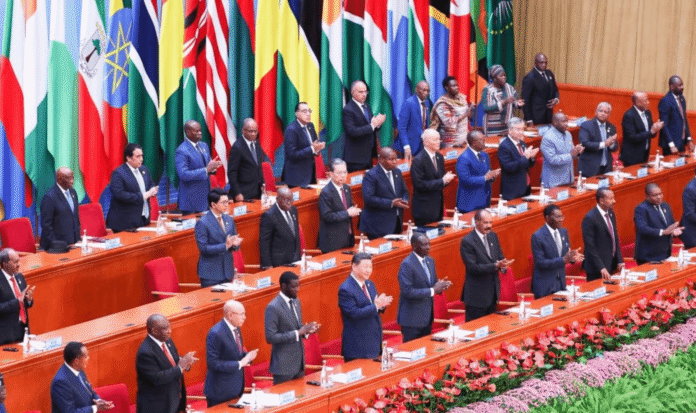
The China zero-tariff Africa policy marks one of the most significant shifts in China-Africa trade relations in recent years, granting duty-free access to imports from 53 African countries.
The move broadens Beijing’s preferential trade framework at a time when uncertainty surrounds the renewal of the United States’ African Growth and Opportunity Act (AGOA) and when African nations continue to face tensions with the European Union over Economic Partnership Agreements.
Until recently, China granted zero-tariff access primarily to least-developed countries (LDCs). Now, the China zero-tariff Africa expansion applies to nearly the entire continent, excluding only Eswatini due to its diplomatic ties with Taiwan.
The expansion of the China zero tariff Africa policy follows sustained diplomatic engagement by African leaders. South African President Cyril Ramaphosa recently visited Beijing to deepen trade discussions. South Africa later signed a non-binding framework agreement, through its Minister of Trade, Industry and Competition, at a Joint Economic and Trade Commission meeting.
Negotiations toward an Early Harvest Agreement are expected to conclude by March 2026. Once finalised, South African exports will gain zero-tariff entry into the Chinese market under the broader China zero-tariff Africa arrangement.
Ugandan President Yoweri Museveni has also consistently called for measures to address structural trade imbalances between China and African economies. His calls align with the broader push for fairer trade terms across the continent.
Trade between China and Africa continues to expand rapidly. Bilateral trade reached $222.05 billion between January and August 2025, up 15.4% year over year.
However, trade remains uneven. Chinese exports to Africa surged by 24.7% to $140.79 billion. In contrast, African exports to China grew by only 2.3%, reaching $81.25 billion. As a result, Africa’s trade deficit with China widened to $59.55 billion during the first eight months of 2025.
African exports still rely heavily on raw materials such as crude oil, copper, cobalt and iron ore. Mineral resources accounted for roughly 40% of China’s imports from African LDCs in 2023. Meanwhile, Chinese exports include machinery, electronics and renewable energy equipment. Africa imported over 15,000 megawatts of Chinese solar panels between July 2024 and June 2025, a 60% increase from the previous year.
Economists estimate that China will forgo approximately $1.4 billion in tariff revenue under the China zero-tariff Africa expansion. Beijing frames the move as a strategy to rebalance trade flows and boost African exports. At the same time, the policy strengthens China’s economic diplomacy and influence across the continent.
The expansion also contrasts with Western trade models. The European Union’s “Everything But Arms” scheme applies primarily to LDCs. Non-LDC African states must negotiate separate Economic Partnership Agreements. The United States’ AGOA programme offers selective access but depends on periodic renewal by Congress.
Despite the removal of tariffs, structural challenges remain. Non-tariff barriers such as regulatory standards, logistics bottlenecks and financing gaps continue to limit African exporters.
Even under the China zero tariff Africa regime, diversification remains critical. African economies must expand manufacturing capacity and move beyond commodity exports if they want to narrow the trade gap sustainably.
Beijing has pledged additional trade facilitation tools and financing products. However, long-term success depends on whether African producers can build competitive value-added industries.
The China zero tariff Africa initiative removes one barrier. It does not, on its own, transform trade structures. The deeper shift will depend on Africa’s industrial policy, infrastructure development and export diversification strategy.