


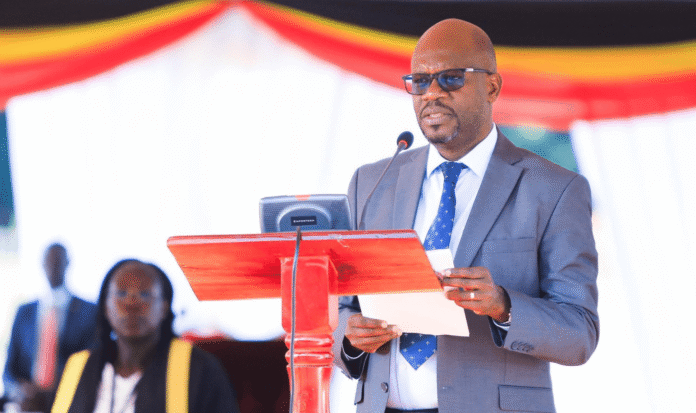
Uganda’s Parliament will debate the Administration of Parliament Amendment Bill 2024 on Thursday. The proposal seeks to change the process for selecting the Leader of the Opposition in the 11th Parliament.
Mityana South MP Richard Lumu of the Democratic Party introduced the bill. It proposes that opposition Members of Parliament elect the Leader of the Opposition rather than allowing the largest opposition party to appoint the Leader of the Opposition automatically.
The Administration of Parliament Amendment Bill 2024 has already sparked debate among political leaders and analysts as lawmakers prepare for the sitting.
Under the current system, the opposition party with the most MPs appoints the Leader of the Opposition. Lumu argues that this arrangement does not reflect the full diversity of opposition voices in Parliament.
“The Leader of the Opposition we have now is more of a leader of the minority. We need a Leader of the Opposition who is elected by all opposition parties in Parliament,” Lumu said.
He also challenged the idea that the majority opinion always produces the best outcome. “It is not true that the majority are always right. The minority can be right, and the majority can be wrong. That is why I believe my bill is right,” he added.
Supporters of the Administration of Parliament Amendment Bill 2024 say an election would strengthen internal democracy within the opposition ranks.
The debate takes place within a Parliament of 555 members. Following the 2021 general election, the National Resistance Movement secured 337 seats. The National Unity Platform holds 57 seats. The Forum for Democratic Change controls 32 seats. The Democratic Party and Uganda Peoples Congress each hold nine seats.
The Justice Forum and the People’s Progressive Party each hold one seat. Parliament also includes 73 independent members and 10 representatives of the Uganda Peoples’ Defence Forces.
Under current law, the National Unity Platform appoints the Leader of the Opposition because it holds the largest number of opposition seats. Joel Ssenyonyi currently occupies that position. Several political actors oppose the Administration of Parliament Amendment Bill 2024. They argue that the proposal could weaken the independence of opposition leadership.
Political observer David Soita Masinde warned that a broader vote might expose the process to indirect influence. He said the proposal does not strengthen democracy but alters the structure of opposition leadership.
Masinde argued that an elected Leader of the Opposition might rely on MPs outside their party, which could affect decision-making. Supporters of the National Unity Platform have also criticised the bill. A supporter who identified himself as Dr Morgan suggested that the proposal appears to target Ssenyonyi.
Morgan explained that the current law allows the largest opposition party to appoint the Leader of the Opposition, the opposition chief whip and the parliamentary commissioner. He said opening the process to all opposition MPs and independents could shift that balance.
“As we await Parliament’s decision on Thursday, allow me to give Joel Ssenyonyi his flowers. Thank you for keeping the regime in check,” Morgan said.
Parliament granted Lumu leave to introduce the private member’s bill on August 29, 2024. Lawmakers tabled the Administration of Parliament Amendment Bill 2024 on October 1, 2024. They later referred the proposal to the Legal and Parliamentary Affairs Committee, chaired by Bukooli North MP Stephen Baka.
Some opposition leaders questioned how quickly the committee processed the bill. Ssenyonyi said he received a letter shortly after tabling, inviting him to present his views.
Baka defended the timeline. He explained that the bill contains fewer clauses than many other proposals before the committee, which allowed members to review it more quickly.
Outside Parliament, Saddam Gayira, chairperson of the People’s Progressive Party, rejected the proposal to elect opposition leadership through a compulsory process.
He said Uganda operates under a multiparty system where parties remain free to associate or disassociate. “There is no party called opposition in Parliament. You cannot make a law that compels different parties to work under one leader when they may not share the same political views,” Gayira said.
As Parliament prepares to debate the Administration of Parliament Amendment Bill 2024, the proposal continues to raise broader questions about party autonomy, representation and the structure of opposition leadership in Uganda.