


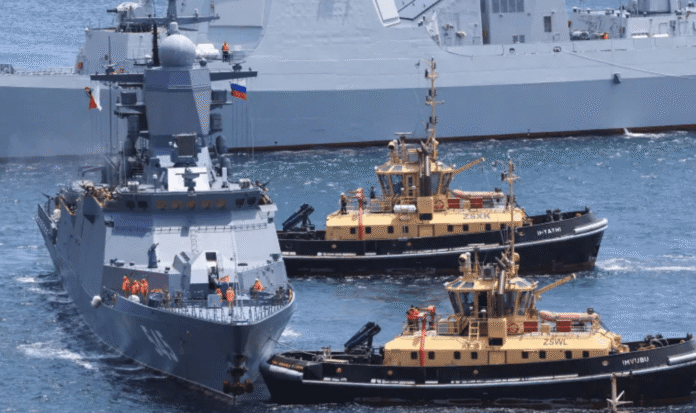
The naval exercises, known as Will for Peace 2026, began on Saturday off the coast of Cape Town. The drills bring together naval forces from several BRICS member and partner states.
South African defence officials say the exercises focus on cooperation, maritime safety and the protection of critical shipping routes. According to officials, these objectives remain central as global sea lanes face growing strain.
The timing of the drills has attracted heightened scrutiny. They began just days after the United States seized a Russian oil tanker linked to Venezuela in the North Atlantic. Washington said the move enforced Western sanctions.
That incident forms part of broader US pressure on Venezuela and has further strained already fragile global relations. As a result, South Africa’s naval engagement has entered a wider geopolitical debate.
Speaking at the opening ceremony, South Africa’s joint task force commander, Nndwakhulu Thomas Thamaha, said the drills go beyond routine military training.
“This is a demonstration of our collective resolve to work together,” he said. He added that cooperation among participating navies remains essential in an increasingly complex maritime environment.
Meanwhile, defence officials stressed that planning for the exercises began well before recent geopolitical developments.
Government Pushes Back Against Criticism
Deputy Defence Minister Bantu Holomisa dismissed suggestions that the drills signal alignment with any single power bloc.
“Let us not press panic buttons because the United States has problems with certain countries,” he said. “Those are not our enemies.”
He emphasised that South Africa’s priority lies in cooperation and maritime safety, particularly in the Indian and Atlantic oceans.
The exercises involve a wide range of naval assets. China and Iran have deployed destroyers, while Russia and the United Arab Emirates have sent corvette vessels. South Africa has contributed a frigate.
In addition, countries including Indonesia, Ethiopia, and Brazil are participating as observers. This mix reflects Pretoria’s emphasis on inclusive multilateral engagement.
The drills were previously known as Exercise Mosi and have taken place periodically since 2019.
This year’s edition was postponed from November after it clashed with the G20 summit in Johannesburg. The summit was boycotted by the US administration, adding another layer of diplomatic tension.
Washington has criticised the expanding BRICS grouping, accusing it of pursuing policies that undermine American interests. US officials have also warned of possible additional tariffs on member countries.
South Africa has faced separate criticism for its close ties with Russia and for filing a case against Israel at the International Court of Justice over the war in Gaza.
Despite this scrutiny, Pretoria insists that its defence and foreign policy decisions reflect national interests rather than allegiance to any single global power.
South African officials say the naval drills align with a long-standing commitment to multilateralism.
They argue that cooperation at sea strengthens regional stability, protects trade routes and reduces the risk of miscalculation during periods of heightened global tension.
For now, South Africa naval drills remain a focal point in a broader debate about neutrality, sovereignty and strategic balance in an increasingly polarised world.